
What is a perps prop firm? How funded perps trading works in 2026
A perps prop firm funds traders to trade perpetual futures after a one-time challenge. How it works, what it costs, how funding rates hit your account, and how perps compare with CME futures, with 30 days of real funding data.

Connor KirstenChief Marketing Officer, Propr
12 min. read
Key takeaways
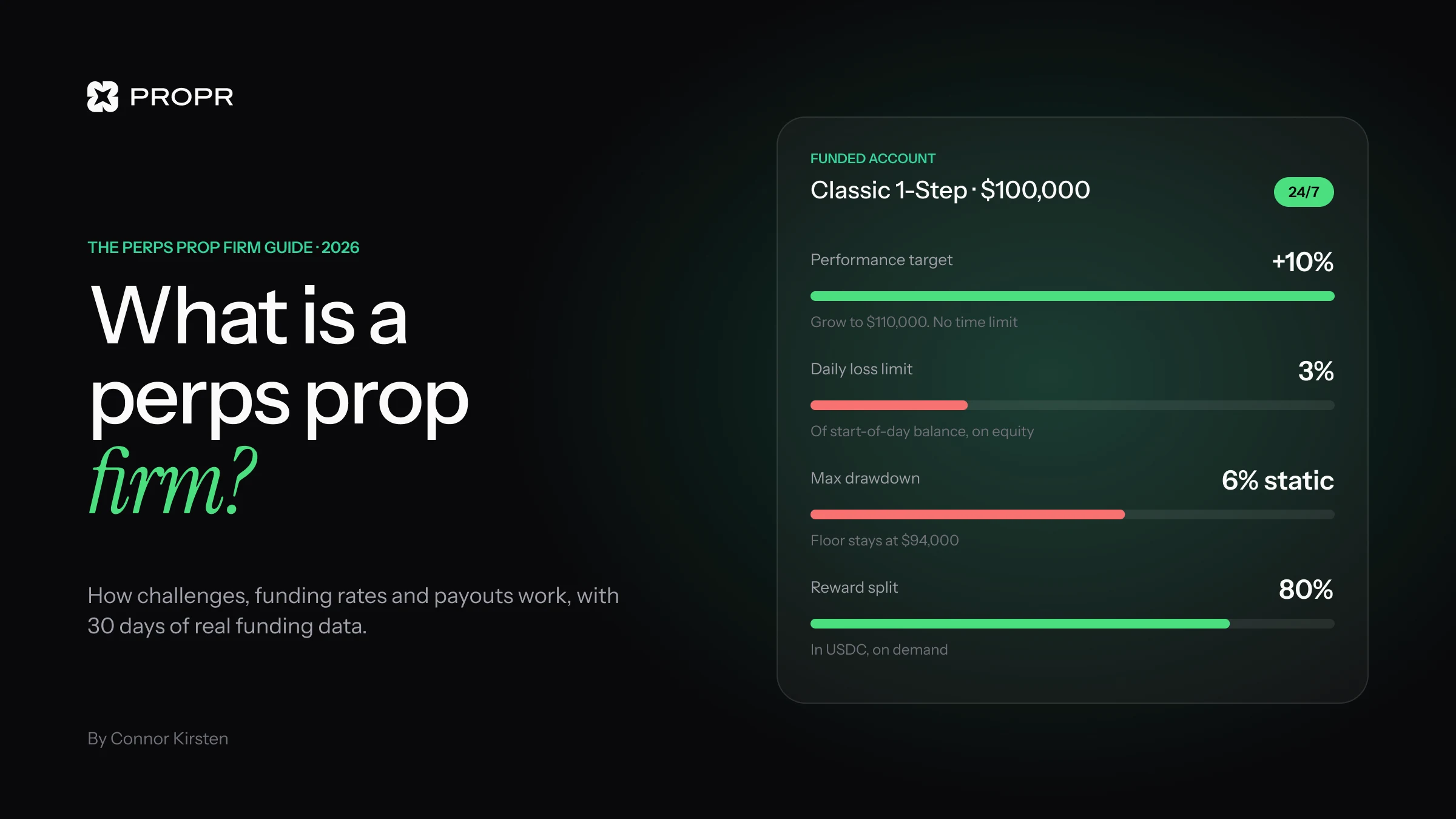
What you buy: a challenge, from $25 for a $5K account to $999 for a $100K account at Propr. You never owe trading losses beyond the fee.
What you trade: perps on crypto, stocks, indices, commodities and forex. At Propr that is 140+ markets on Hyperliquid, all 24/7.
What you must not break: at Propr, a 3% daily loss limit and a static drawdown of 3% to 6% on 1-Step challenges (8% trailing on the 2-Step).
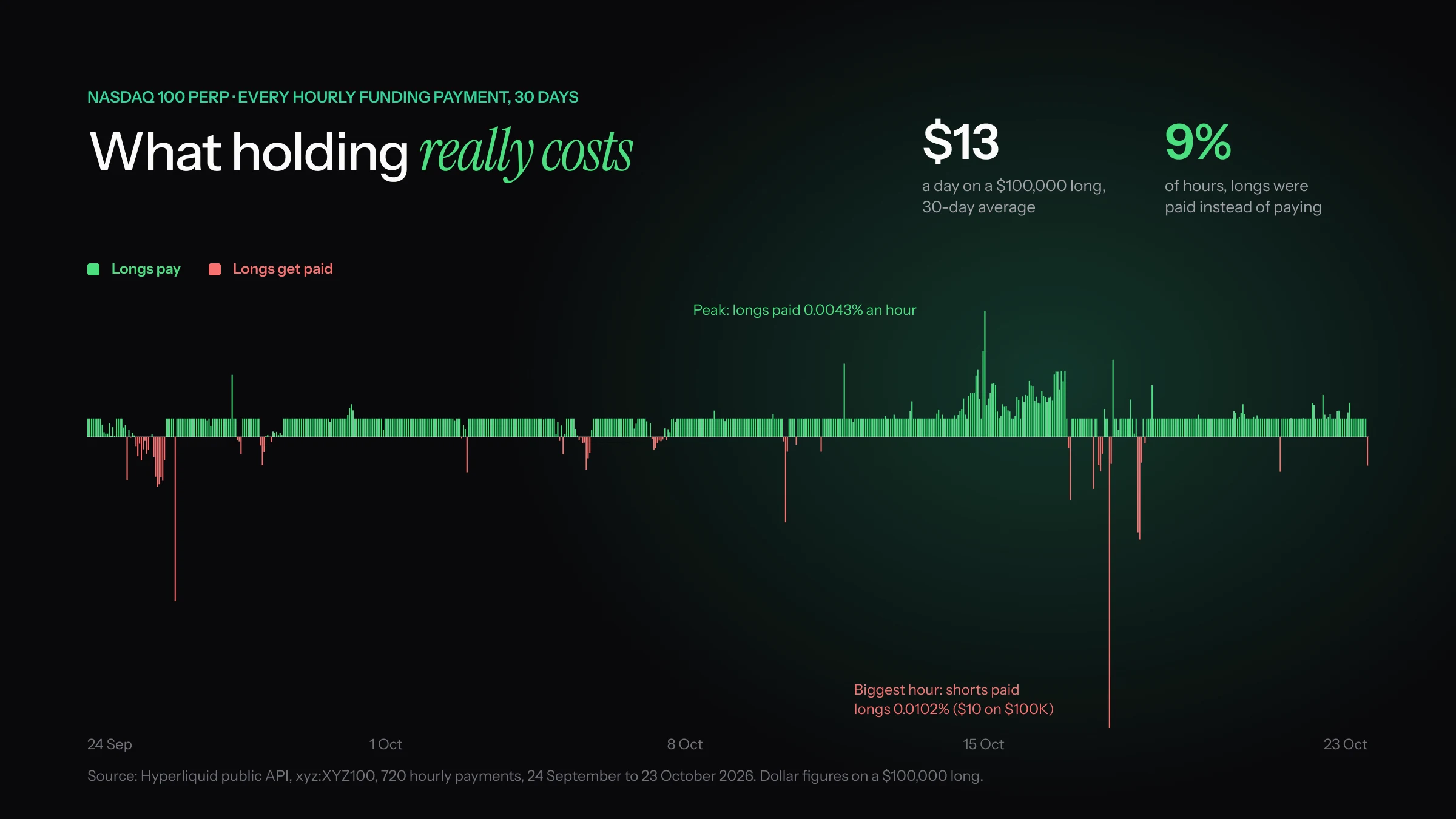
What it costs to hold: funding, paid or received every hour. Over the last 30 days a $100,000 long on the Nasdaq 100 perp cost about $13 a day.
How you get paid: at Propr, on demand in USDC from $20, with an 80% reward split.
Quick answer
A perps prop firm gives traders funded capital to trade perpetual futures (perps). You pay a one-time challenge fee, trade a simulated account to a performance target without breaking two loss limits, then keep a share of what you make on a funded account: 80% at Propr. Perps have no expiry and trade 24/7, so there is no rollover and no closed market at the weekend.
How a perps prop firm works
A perps prop firm works in four steps. Here they are at Propr, on a Classic 1-Step, $100,000 account, from the rules page.
Step | What happens | Propr Classic 1-Step, $100K |
|---|---|---|
1. Buy a challenge | One-time fee for a simulated account | $999 |
2. Trade it | Hit the performance target. No time limit or minimum days | +10%, so $110,000 |
3. Stay inside the limits | Daily loss limit and maximum drawdown, both checked on equity | 3% a day, 6% static floor at $94,000 |
4. Get funded and paid | Funded account with the same limits and no target. Request rewards when you want | 80% reward split, USDC, $20 minimum |
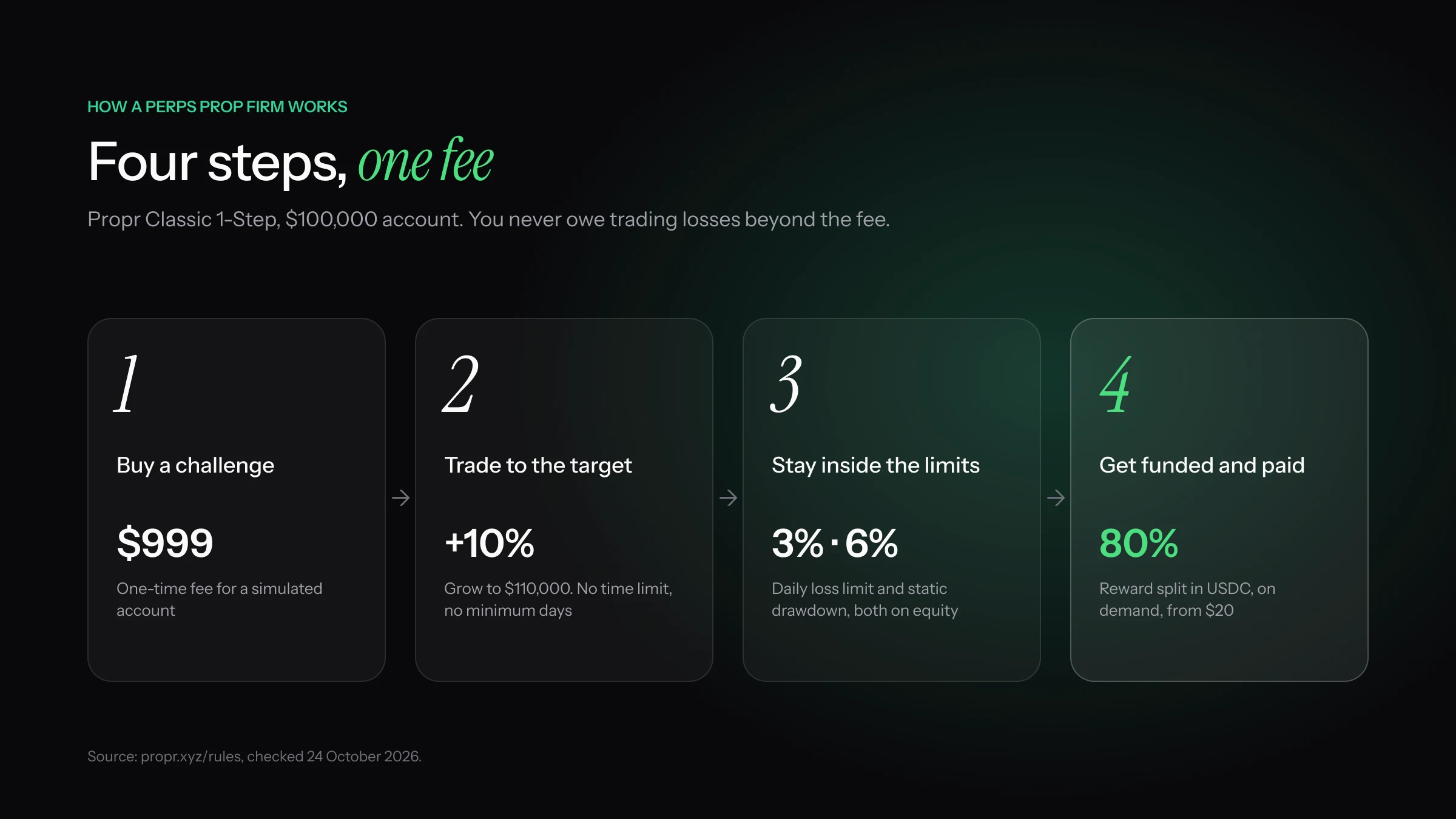
Two details trip up new traders. Both limits count floating losses, so an open trade can breach the account before you close it. And a reward request at Propr sweeps all profit above the starting balance and resets the account to it, so you choose when to bank rather than drip out small amounts.
What are perps?
A perpetual future is a futures contract with no expiry date. You go long or short with leverage, exactly as with a dated future, but the position can stay open for as long as your margin and the firm's rules allow.
Because a perp never settles, something has to keep its price close to the real market. That job falls to funding: a small payment between longs and shorts, made every hour on Hyperliquid. When the perp trades above the index, longs pay shorts. When it trades below, shorts pay longs.
Perps started in crypto. Since late 2025, venues such as Hyperliquid list perps on stocks, indices, gold and oil too, which is why a perps prop firm can now offer the Nasdaq 100 next to Bitcoin.
Perps vs futures: what changes for a futures trader
If you trade NQ or ES at a futures prop firm, the trade idea stays the same. The mechanics around it change. For the rule-by-rule switch, from drawdown to payouts, see Futures prop firm vs perps prop firm.
CME futures (NQ, MNQ) | Perps on Propr | |
|---|---|---|
Expiry | Quarterly, so you roll every three months | None, no rollover |
Hours | Sunday to Friday, with a daily break | 24/7, including weekends |
Sizing | Whole contracts: NQ $20 a point, MNQ $2 | Units or dollars, in any size. 1 unit of the Nasdaq 100 perp is $1 a point |
Leverage | Set by margin per contract | You pick it, up to a cap per market. 10x on the Nasdaq 100 at Propr |
Trading costs | Commission per contract | A percentage of order value. 0.009% taker at Propr on indices |
Holding cost | Built into the roll | Hourly funding, paid or received |
Payouts | Bank transfer or payment platform, usually after minimum days | USDC, on demand |
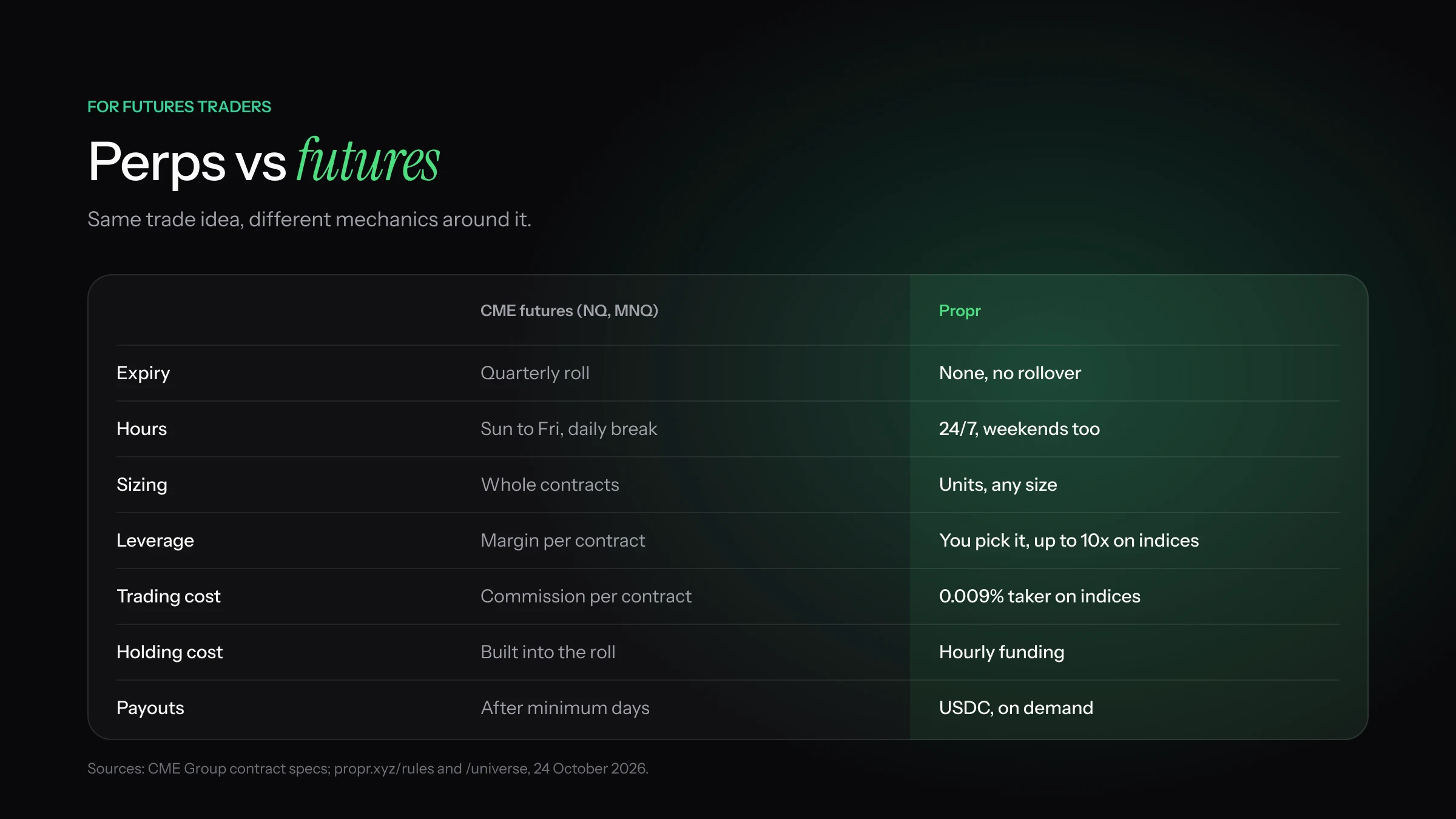
Sizing is the step that catches people out. 4 MNQ is $8 a point, so the same exposure on Propr is 8 units of the Nasdaq 100 perp. Most order tickets default to a dollar size, so convert before you click.
Are perps better than futures?
Neither is better. Perps suit traders who want weekend and overnight access without a roll, fractional sizing, and fast USDC payouts. CME futures suit traders who want a regulated exchange, deep liquidity at the open, and no funding cost on long holds. Some futures traders use both: CME during the session, perps when it is closed.
Funding rates: what holding a position really costs
Funding is the cost most traders forget to price in. On Hyperliquid it is charged every hour, as a percentage of your position value. A positive rate means longs pay shorts, a negative one means shorts pay longs.
These are the averages across all 720 hourly funding payments from 24 September to 24 October 2026, from Hyperliquid's public data.
Market | Average per day | A day on a $100,000 long | Annualised | Hours when longs were paid |
|---|---|---|---|---|
Bitcoin | 0.0228% | $22.80 | 8.3% | 7% |
Ether | 0.0223% | $22.30 | 8.1% | 9% |
Nasdaq 100 (XYZ100) | 0.0130% | $13.00 | 4.7% | 9% |
S&P 500 | 0.0067% | $6.70 | 2.4% | 24% |
Gold | 0.0175% | $17.50 | 6.4% | 3% |
Three things follow from this.
Intraday trades barely notice it. An hour of funding on a $100,000 Nasdaq 100 long averaged about 54 cents, against $18 in round-trip taker fees at Propr.
Swing trades should price it in. A week long on $100,000 of the Nasdaq 100 averaged about $91 in funding.
Averages hide spikes. The Nasdaq 100 rate ranged from −0.0102% to +0.0043% an hour over the month.
Propr applies Hyperliquid's live hourly rate, with no fixed daily swap on top. You pay or receive what the market sets, and on 9% of hours last month, longs on the Nasdaq 100 were paid to hold.
What a perps prop firm costs
There are three costs: the challenge fee, trading fees and funding.
Challenge fees at Propr, $100,000 account
Challenge | Fee | Performance target | Max drawdown |
|---|---|---|---|
Turbo 1-Step | $450 | 9% | 3% static |
Pro 1-Step | $699 | 12% | 5% static |
Classic 2-Step | $749 | 5%, then 10% | 8% trailing |
Classic 1-Step | $999 | 10% | 6% static |
The cheaper challenges have tighter rules: the $450 Turbo has a 3% static drawdown, while the $999 Classic gives you 6%. The cheapest way to buy a challenge is rarely the cheapest way to pass one. Every fee is one-time, with no subscription and no activation fee. By comparison, a $50K evaluation at the large US futures prop firms costs $49 to $95 a month at one, or about $125 to $210 one-time at the others, plus up to $149 to activate a funded account.
Trading fees are charged on order value. At Propr, stock, index, commodity and forex perps cost 0.009% taker and 0.003% maker, and crypto costs 0.045% taker and 0.015% maker. A round trip on $100,000 of the Nasdaq 100 with market orders is $18.
Propr's rules, and how they compare with futures prop firms
Propr has two trading rules. Everything else is up to you.
Daily loss limit: 3% of your start-of-day balance on 1-Step challenges, 5% on the 2-Step, reset at 00:00 UTC and checked on equity, so open trades count.
Maximum drawdown: static on every 1-Step challenge (6% Classic, 5% Pro, 3% Turbo). The floor is set when the account opens and never moves. Large US futures prop firms mostly trail the drawdown at the end of each day, so a good day raises your floor.
No consistency rule: no cap on how much of your profit comes from one day. Most futures prop firm evaluations ask that your best day stays under 40% to 55% of total profit.
Leverage caps per market: 10x on Bitcoin, Ether, Solana, the Nasdaq 100 and S&P 500, 8x on gold, silver and oil, 4x on stocks, 2x on most other crypto and 25x on forex. You choose any leverage up to the cap.
What is allowed: news trading, weekend holds, bots, EAs and copy trading between your own accounts. Futures prop firms usually make you flat before the 4pm ET close.
Are perps prop firms real money?
Propr accounts are simulated, as they are at futures prop firms. Your orders do not hit an exchange in your name. Propr prices them off Hyperliquid's live markets and pays you a share of the performance you record once funded.
A prop firm earns from challenge fees and from what it does with the trading signals. That only works long term if it can pay its best traders, so the question to ask is how it covers payouts. Propr hedges part of its exposure onchain on Hyperliquid and publishes those positions, its reserve wallets and its full payout history on the transparency dashboard. By 22 October 2026 that hedging book had made $695,524 of realised profit, about 22% of the $3.21M paid to traders.
Are perps risky?
Yes, in four ways.
Leverage cuts both ways. At 10x a 1% move against you is 10% of the margin on that trade, and a 3% daily limit goes quickly.
Funding adds a running cost on held positions, and it can spike.
Markets never close. A weekend move can hit your daily limit while you sleep, so use stops.
Firm risk. Any prop firm is only as good as its ability to pay. Check its payout record and where the money comes from, which is why Propr publishes both.
On a prop firm, your loss is capped at the challenge fee. That is the main reason traders use one instead of trading perps with their own money.
Five things to check before you buy, and where to find them for Propr
Payouts: real payout data, not testimonials. Propr publishes every payout on the transparency dashboard: $3.21M paid to traders by 22 October 2026.
Reserve: where payouts come from. Propr's reserve wallets and hedging positions are onchain, so anyone can check them.
Rules: static or trailing, and whether open trades count. At Propr: static on every 1-Step, both limits on equity.
Costs: taker fees and how holding is priced. At Propr: 0.009% taker on stocks, indices, commodities and forex, 0.045% on crypto, and live hourly funding.
Reviews: read the one-star reviews on Trustpilot, not just the average.
Frequently asked questions
What is a perps prop firm?
A perps prop firm funds traders to trade perpetual futures. You pay a one-time challenge fee, hit a performance target on a simulated account without breaking the daily loss and drawdown limits, and keep a share of profits once funded. At Propr that is an 80% reward split, paid in USDC.
What is the difference between a perps prop firm and a futures prop firm?
A futures prop firm trades dated CME contracts such as NQ and ES during exchange hours, sized in whole contracts. A perps prop firm trades perpetual futures with no expiry, 24/7, sized in units or dollars, with hourly funding instead of quarterly rolls.
How much is a $100,000 account at Propr?
At Propr, $450 (Turbo 1-Step) to $999 (Classic 1-Step), one-time. You never owe trading losses beyond the fee.
Does Propr charge funding?
Propr applies Hyperliquid's hourly funding rate, which you pay or receive, with no fixed daily swap. Over the 30 days to 24 October 2026, a $100,000 Nasdaq 100 long averaged about $13 a day.
Can I trade the Nasdaq 100 or gold on Propr?
Yes. Propr lists the Nasdaq 100 and S&P 500 at up to 10x, gold, silver and oil at up to 8x, and 47 stocks, all tradable 24/7.
What is a Hyperliquid prop firm?
A perps prop firm that prices its accounts off Hyperliquid's markets. Propr is built on Hyperliquid: it mirrors Hyperliquid's prices and funding, and hedges part of its exposure there in positions anyone can check.
Can US traders use Propr?
Yes. Propr accepts traders in the US and UK. Check the restricted countries in the terms before you buy.
Is Propr legit?
Propr has paid $3.21M to traders (22 October 2026) and publishes every payout, its reserve wallets and its hedging positions on the transparency dashboard. Like any prop firm it sells challenges, not brokerage accounts, so judge it on that published record.
About the author
Connor Kirsten is Chief Marketing Officer at Propr and a founding team member of XBorg, the team that builds it. He has traded forex since 2016 and crypto since 2019, and writes Propr's comparisons and trading guides. X
Sources
Propr rules, asset universe and fees and transparency dashboard, checked 24 October 2026. Funding data: Hyperliquid public API, all hourly funding payments from 24 September to 24 October 2026. Futures prop firm comparisons: help centres of five large US futures prop firms, checked 25 October 2026. CME contract sizes: CME Group contract specifications.
Propr is an educational and evaluation service offered by Propr Limited, which is not licensed or regulated by the Financial Services Commission of the British Virgin Islands, or any US or EU financial authority. This service does not constitute a crypto-asset service or financial instrument, and falls outside the scope of the EU Markets in Crypto-Assets Regulation (MiCA). Availability varies by jurisdiction, and users are responsible for compliance with local laws. By participating, you are providing simulated trading signals to Propr Limited, you are not trading live financial instruments on your own behalf. Propr Limited exercises sole discretion over whether to replicate or act upon your signals in live trades. Evaluation fees are paid solely for platform access and are non-refundable. Any payout received is a performance fee based on evaluation metrics, not a return on capital or investment.