
Futures prop firm vs perps prop firm: what changes when you switch
Topstep, Apex, My Funded Futures, Tradeify and Lucid against Propr, rule by rule, for futures traders thinking about perps. Drawdown, daily loss, consistency, hours, payouts and how to size NQ and MNQ in units.

Connor KirstenChief Marketing Officer, Propr
10 min. read
Key takeaways
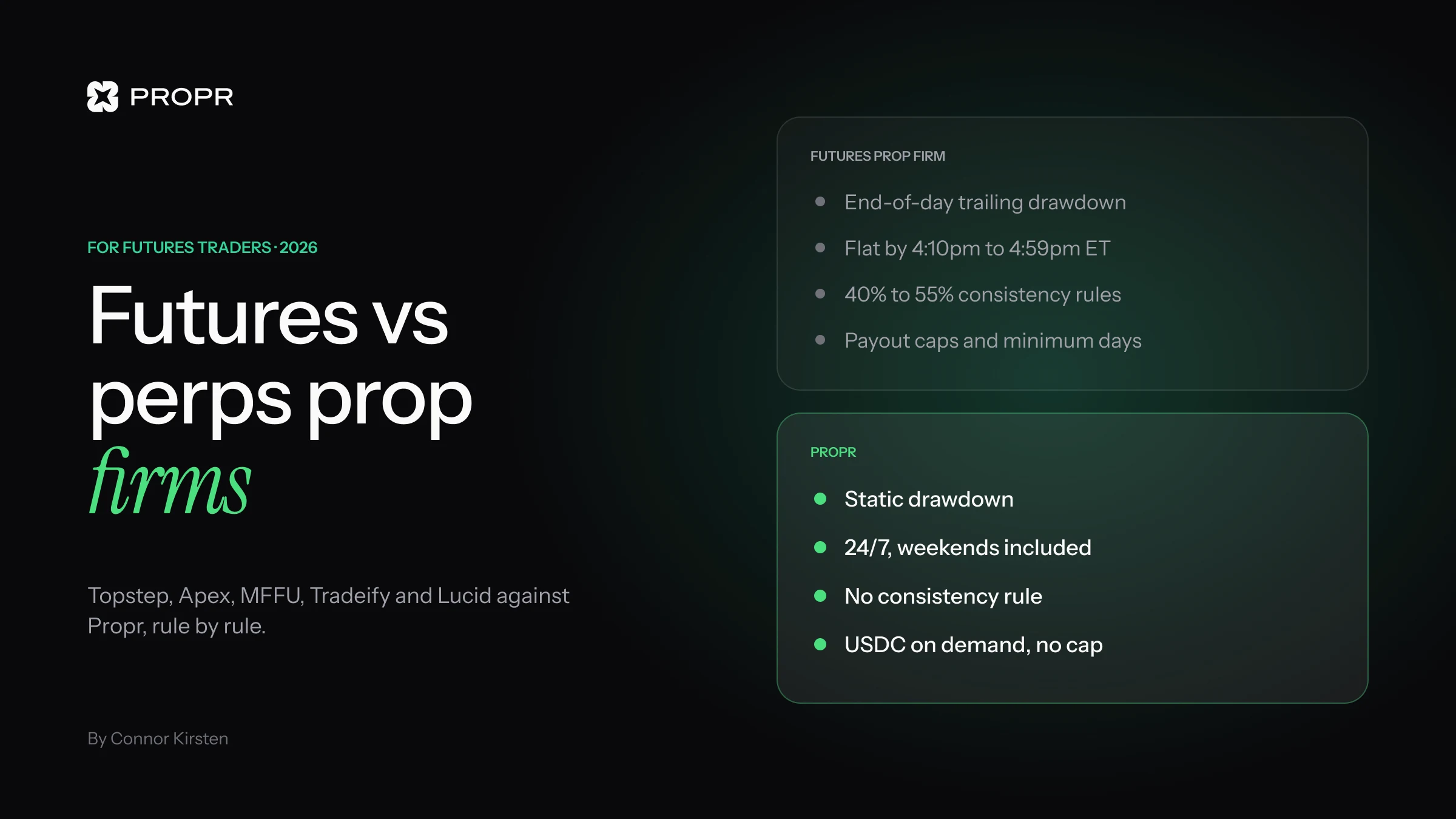
Drawdown: end-of-day trailing at the large US futures firms. Static on Propr's 1-Step challenges.
Hours: flat by 4:10pm to 4:59pm ET at futures firms. 24/7 on perps, weekends included.
Consistency: 40% to 55% best-day rules in most futures evaluations. None at Propr.
Payouts: 90% or 100% splits at futures firms, with minimum days and caps per request. 80% at Propr, on demand, no cap.
Size: 4 to 6 minis at $50K on a futures firm. About 8 to 9 MNQ of Nasdaq exposure at Propr's 10x limit on $50K.
Quick answer
A futures prop firm and a perps prop firm sell the same thing, a challenge that leads to a funded account, but the rules sit in different places. Futures prop firms like Topstep and Apex trail your drawdown at the end of each day, ask you to be flat by the 4pm close and cap each payout. A perps prop firm like Propr fixes the drawdown floor where it starts, lets you hold through the night and the weekend, and pays on demand in USDC, but it enforces a hard daily loss limit and you trade smaller size.
If you have not traded perps before, read What is a perps prop firm? first. This guide covers only what changes in the rules.
The $50K account, side by side
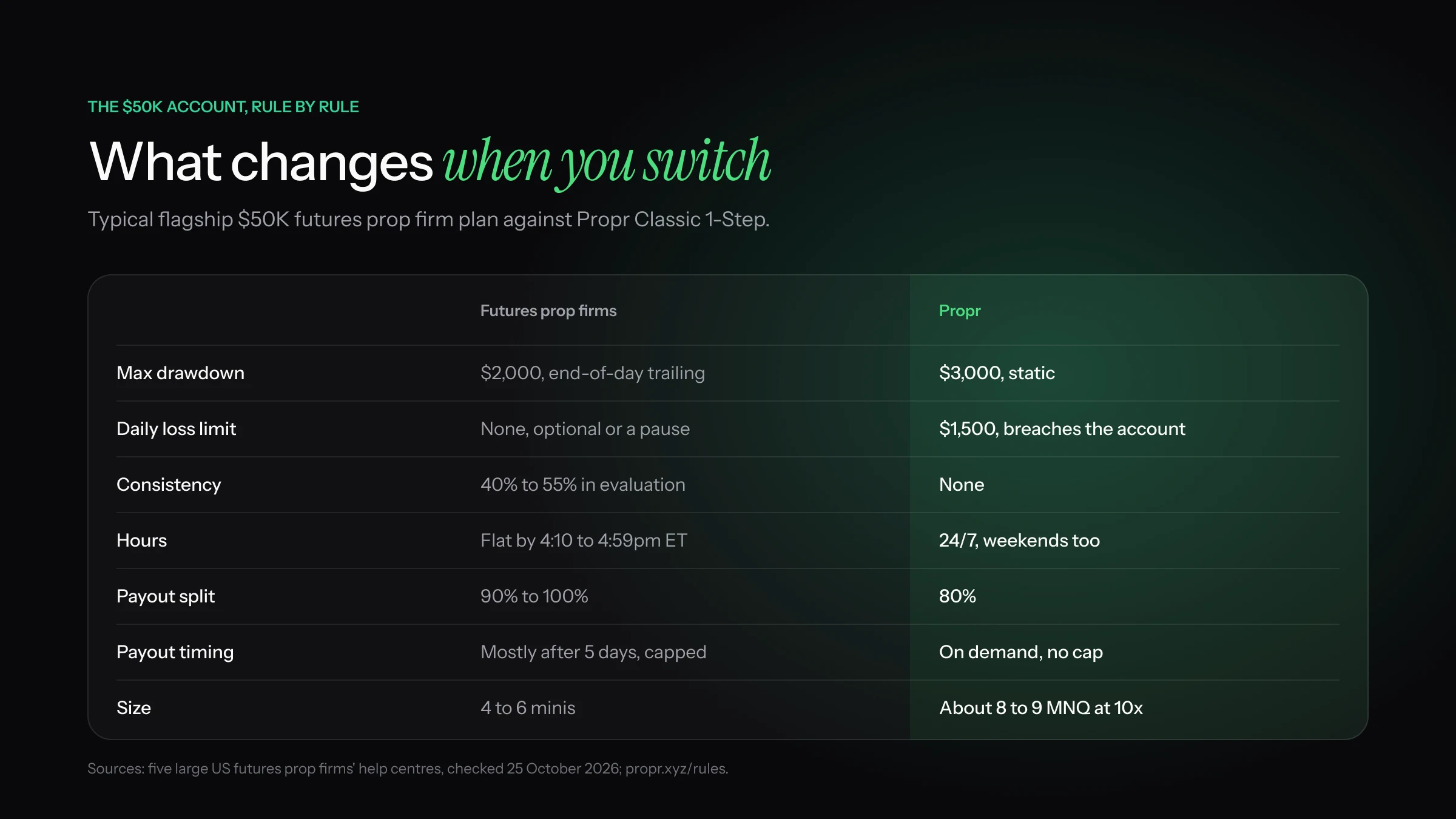
Each firm's flagship $50K plan, from its own help centre, checked 25 October 2026.
Topstep Combine | Apex EOD | MFFU Rapid | Tradeify Select | Lucid Flex | Propr Classic 1-Step | |
|---|---|---|---|---|---|---|
Fee | $49 or $95 a month | One-time | $209 one-time | $165 one-time | One-time | $495 one-time |
Funded activation fee | $149, or $0 on the $95 path | Varies, with a $0 option | $0 | $0 | $0 | $0 |
Profit or performance target | $3,000 | $3,000 | $3,000 | $3,000 | $3,000 | $5,000 |
Max drawdown | $2,000, end-of-day trailing | $2,000, end-of-day or intraday trailing | $2,000, end-of-day trailing | $2,000, end-of-day trailing | $2,000, end-of-day trailing | $3,000, static |
Daily loss limit | Optional, $1,000 | $1,000, pauses the day | None | None | Optional | $1,500, breaches the account |
Consistency rule | Best day under 55% | None in evaluation | 50% in evaluation | 40% in evaluation | 40% in evaluation | None |
Hours | Flat by 4:10pm ET | Flat by 4:59pm ET | Flat by 4:10pm ET | Flat by 4:45pm ET | Flat by 4:45pm ET | 24/7 |
Payout split | 90% | 100% | 90% | 90% | 90% | 80% |
Bots | Allowed, with conditions | Banned | Allowed | Allowed | Allowed | Allowed |
Apex and Lucid show prices only in their checkout, so their fees are not listed. Sources for every row are linked at the end.
What changes, rule by rule
1. Trailing drawdown becomes static
This is the biggest change, and the reason most futures traders look at perps.
On an end-of-day trailing drawdown, your floor follows your best closing balance up until it locks near the starting balance. On a static drawdown, the floor is set on day one and never moves.
Take a $50K account. You close day one up $1,800, then give back $2,000 on day two.
Floor after day one | Equity after day two | Result | |
|---|---|---|---|
$2,000 end-of-day trailing | $49,800 | $49,800 | Breached |
Propr, 6% static | $47,000 | $49,800 | $2,800 of room left |
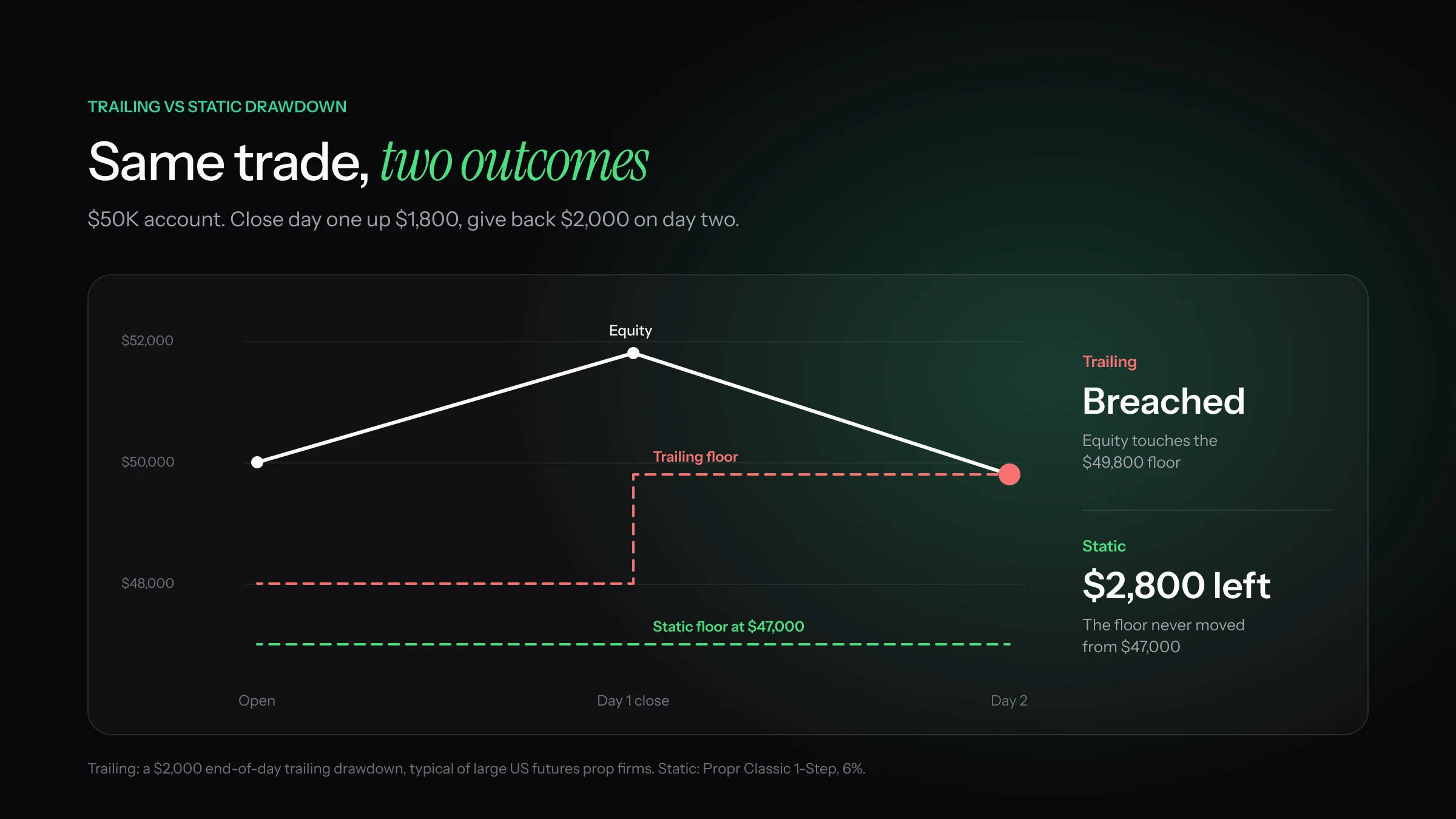
A static floor means a good day never shrinks your room. The trade-off is the target: Propr asks for 10% ($5,000) against $3,000 at most futures firms, so you need a bigger run to pass, with more room to make it.
2. The daily loss limit gets stricter
Most futures firms either have no daily loss limit or treat it as a pause: Apex stops you trading for the day. Propr does not: equity touching the daily limit breaches the account.
At Propr the limit is 3% of your start-of-day balance, so $1,500 on $50K, reset at 00:00 UTC and checked on equity, including open trades. Plan your stops around it, not just around the drawdown.
3. Consistency rules go away
Topstep's Combine asks that your best day stays under 55% of total profit, and MFFU, Tradeify and Lucid use 40% or 50% in their evaluations. One big day can push your target out of reach.
Propr has no consistency rule, no minimum days and no time limit. You can pass in one trade.
4. The 4pm close disappears
The large futures firms make you flat before the daily close, and none let you hold over the weekend. CME equity index futures themselves trade Sunday to Friday, 6pm to 5pm ET, with a daily one-hour break.
Perps trade 24/7. On Propr you can hold the Nasdaq 100, S&P 500, gold and oil overnight and through the weekend. Holding is not free: funding is charged or paid every hour. Over the 30 days to 24 October 2026, a $100,000 Nasdaq 100 long averaged about $13 a day in funding. See the full funding data.
5. Payouts work differently
Futures firms (50K) | Propr | |
|---|---|---|
Split | 90% (Apex 100%) | 80% reward split |
When | Usually after 5 qualifying days, or daily once a profit buffer is built | On demand, any time, all positions closed |
Minimum | $125 to $500 | $20 |
Cap per request | Usually $1,500 to $3,000 (Apex, Lucid, Tradeify Flex) | None. A request sweeps all profit above the starting balance |
Method | Bank, ACH, Rise, Plane, PayPal and others | USDC, onchain |
At a futures firm you keep more of each payout, but the firm limits how much you can take and when. At Propr you keep 80%, with no limit on timing or size.
6. Contracts become units
On a perps prop firm you size in units, not contracts. One unit of a Hyperliquid index perp moves $1 per point.
CME contract | Point value | Propr market | Units for 1 contract |
|---|---|---|---|
NQ | $20 | XYZ100 (Nasdaq 100) | 20 |
MNQ | $2 | XYZ100 | 2 |
ES | $50 | SP500 | 50 |
MES | $5 | SP500 | 5 |
GC | 100 oz | GOLD | 100 |
MGC | 10 oz | GOLD | 10 |
CL | 1,000 bbl | CL | 1,000 |
MCL | 100 bbl | CL | 100 |
Size is the honest catch. A $50K futures account lets you trade 4 to 6 minis. Propr caps the Nasdaq 100 at 10x, so $50K holds about $500,000 of exposure, about 17 units of XYZ100, or 8 to 9 MNQ. Your stops can be wider for the same dollar risk, but you will not trade 5 NQ on a $50K perps account.
Worked example: 4 MNQ on Propr
You would buy 4 MNQ at 28,931.50 with a 40-point stop and an 80-point target. On Propr's $50K Classic 1-Step:
What to enter | Value |
|---|---|
Market | XYZ100 |
Size | 8 units (4 MNQ × 2), about $231,450 |
Leverage | 5x, the lowest that fits in $50K |
Stop loss | 28,891.50 |
Take profit | 29,011.50 |
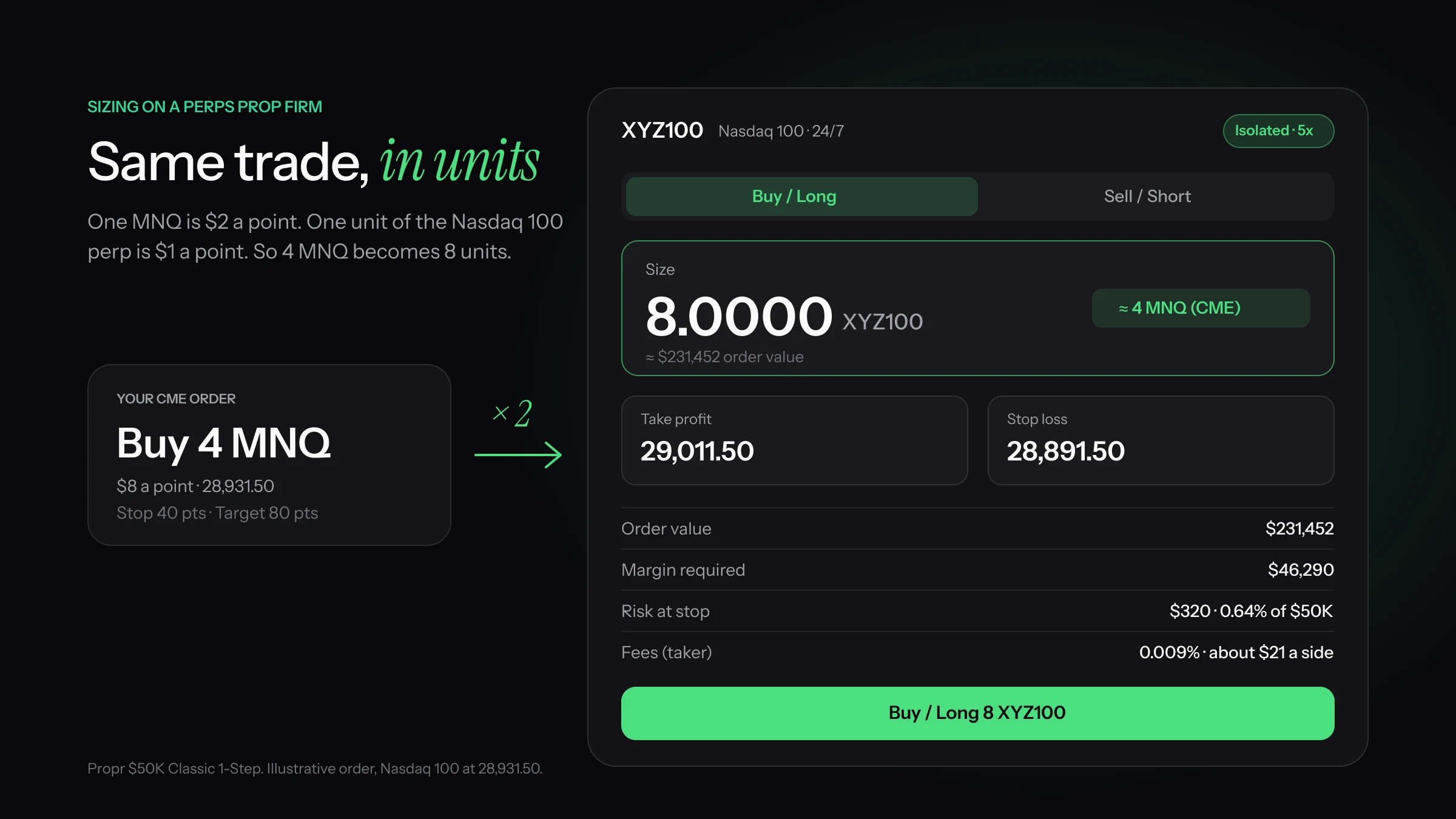
Risk at the stop is $320, or 0.64% of the account. At the target you make $640 before about $42 of round-trip taker fees. Against the $1,500 daily limit, four losses like this fit in one day.
Which suits you
Stay with a futures firm if you trade the New York session only, size in multiple minis, want the highest split, or need the cheapest entry. Topstep starts at $49 a month, and MFFU, Tradeify and Lucid sell one-time $50K evaluations for under $210.
Try a perps prop firm if trailing drawdown keeps taking your accounts, you want to hold through the close or trade the weekend, consistency rules cost you passes, or you want payouts in USDC on demand.
Some traders run both: CME during the session, perps when it is closed.
Futures firms are moving into perps
The line between the two is blurring. In 2026, several futures prop firms launched or announced perps programmes, and they lead with the same two things: static drawdown and round-the-clock trading. That is the perps prop firm model, now being built into the firms futures traders already know.
Frequently asked questions
Is Propr better than a futures prop firm?
Neither is better for everyone. Propr suits traders who want a static drawdown, no consistency rule, 24/7 hours and on-demand USDC payouts. Futures firms like Topstep and Apex suit traders who want cheaper entry, higher splits and bigger contract size during the New York session.
Can I trade NQ on Propr?
Yes, through a Nasdaq 100 perp. On Propr it is XYZ100, at up to 10x, trading 24/7. One NQ equals 20 units and one MNQ equals 2 units.
Does Propr use trailing drawdown?
Not on 1-Step challenges, which are all static. Propr's 2-Step challenge trails, and stops at the starting balance.
Can I hold trades overnight and over the weekend on Propr?
Yes. Propr has no weekend holding rule. Hourly funding applies while a position is open.
Does Propr have a consistency rule?
No. Propr has none: no consistency rule, no minimum days and no time limit.
Do Topstep or Apex offer perps?
No. Topstep lists only CME contracts, including micro Bitcoin and Ether futures, and we found no perps product at Apex. A few other futures firms launched or announced perps programmes in 2026.
About the author
Connor Kirsten is Chief Marketing Officer at Propr and a founding team member of XBorg, the team that builds it. He has traded forex since 2016 and crypto since 2019, and writes Propr's comparisons and trading guides. X
Sources
All checked 25 October 2026.
Topstep: pricing, Combine parameters, maximum loss limit, daily loss limit, consistency, payout policy, trading hours.
Apex Trader Funding: EOD evaluations, EOD drawdown, EOD payouts, trading times, prohibited activities.
My Funded Futures: Rapid 50K, plans, trading times.
Tradeify: pricing, Select evaluation, payouts, trading rules.
Lucid Trading: LucidFlex evaluation, drawdown, payouts, trading times, FAQ.
CME Group: E-mini Nasdaq-100 specs, micro equity index FAQ, gold fact card, micro WTI fact card.
Propr: rules, markets and fees.
Propr is an educational and evaluation service offered by Propr Limited, which is not licensed or regulated by the Financial Services Commission of the British Virgin Islands, or any US or EU financial authority. This service does not constitute a crypto-asset service or financial instrument, and falls outside the scope of the EU Markets in Crypto-Assets Regulation (MiCA). Availability varies by jurisdiction, and users are responsible for compliance with local laws. By participating, you are providing simulated trading signals to Propr Limited, you are not trading live financial instruments on your own behalf. Propr Limited exercises sole discretion over whether to replicate or act upon your signals in live trades. Evaluation fees are paid solely for platform access and are non-refundable. Any payout received is a performance fee based on evaluation metrics, not a return on capital or investment.