Propr 1-Step Max vs Vest: leverage, weekends, fees and price compared
Propr 1-Step Max against Vest's 1-Step, rule by rule: weekday and weekend leverage, news days, daily loss limits, fees, price, drawdown and payouts, with every Vest fact linked.

Connor KirstenChief Marketing Officer, Propr
9 min. read
On this page (7)
Key takeaways
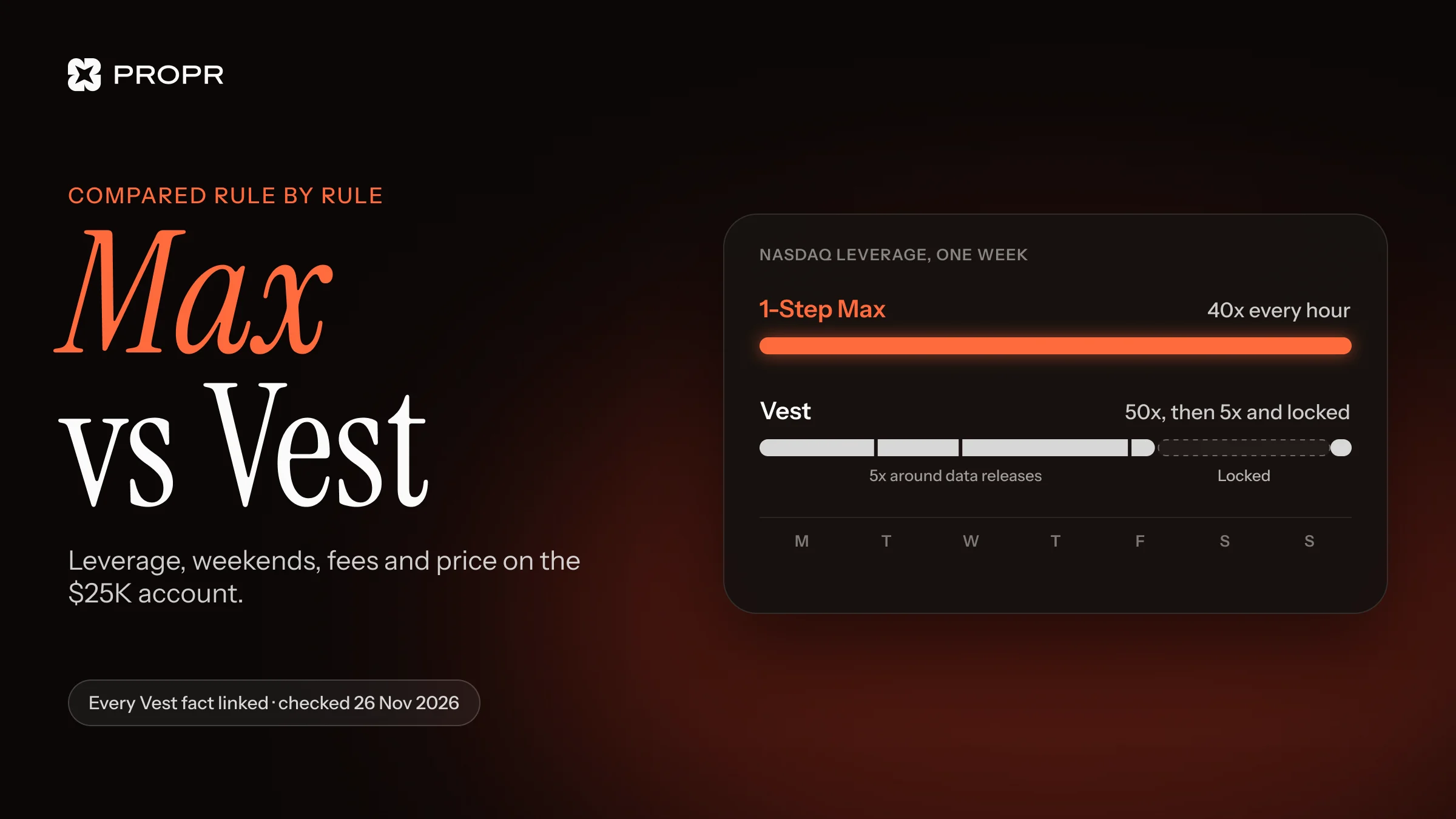
Leverage: Vest goes higher on weekdays, 50x on the Nasdaq 100 and 75x on the S&P 500. Max holds 40x around the clock, while Vest cuts indices to 5x from Friday 4:10 PM ET and around major releases.
Weekends: Vest locks index and commodity markets from Friday 5 PM to Sunday 6 PM ET. Max stays open.
Price: $249 for a $25K Max against $430 for Vest's default $25K 1-Step. Max includes a 3% daily loss limit; Vest's new plans have none.
Where Vest wins: more drawdown room, a split of up to 95%, 0% maker fees and no daily loss limit.
Disclosure. Written by Connor Kirsten, Chief Marketing Officer at Propr. We sell one of these two products, so every Vest fact below links to Vest's own docs or pricing page, checked on 26 November 2026, and we say where Vest wins.
Quick answer
Pick Vest if you trade the US session, want the most leverage while it's open and would rather have no daily loss limit. Pick Propr's 1-Step Max if you want the same leverage at any hour, including Friday afternoon, the weekend and data releases, lower fees on market orders and a cheaper challenge, and you're happy to trade with a 3% daily loss limit.
Side by side: the $25K account
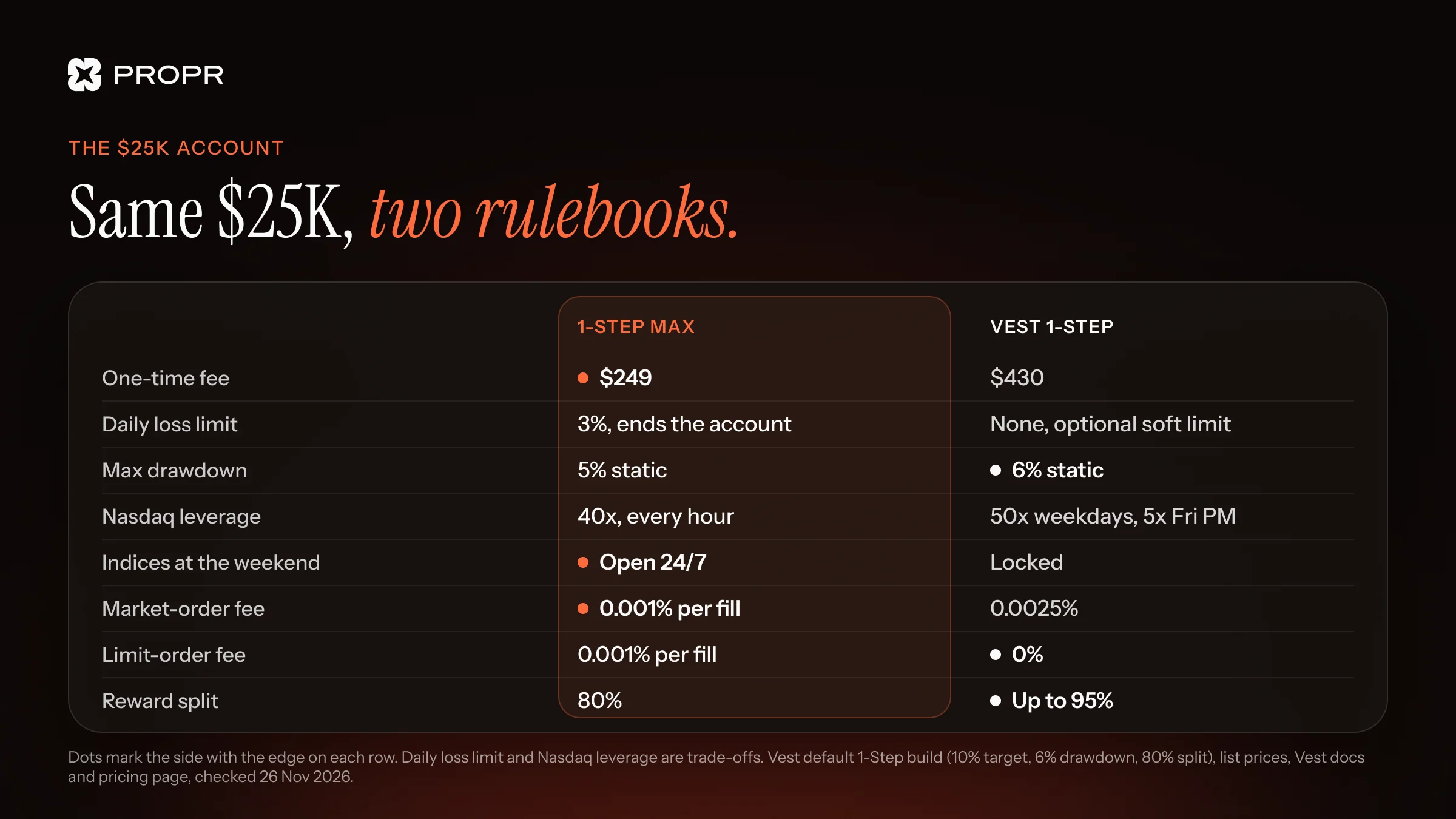
Propr 1-Step Max | Vest 1-Step | |
|---|---|---|
One-time fee | $249 | $430 |
Performance target | 10% | 10% (5% to 20%, your choice) |
Max drawdown | 5% static | 6% static (6% to 8%, your choice) |
Daily loss limit | 3%, ends the account | None. An optional self-set limit closes positions, not the account |
Nasdaq 100 leverage | 40x, every hour | 50x, 5x from Fri 4:10 PM ET and around major releases |
S&P 500 leverage | 40x, every hour | 75x, 5x from Fri 4:10 PM ET and around major releases |
Gold leverage | 20x, every hour | 25x, 3x from Fri 4:10 PM ET and around major releases |
Oil (WTI) leverage | 10x | 10x |
Indices at the weekend | Open 24/7 | Locked Fri 5 PM to Sun 6 PM ET |
Fee on market orders, indices | 0.001% per fill | 0.0025% |
Fee on limit orders, indices | 0.001% per fill | 0% |
Reward split | 80% | 80% (70% to 95%, your choice) |
Largest account | $50,000 | $50,000 |
Payouts | On demand from $20, USDC, no cap | On demand, processed within 24 hours, no minimum |
Every payout and reserve published | Yes | No |
Vest's default 1-Step build (10% target, 6% drawdown, 80% split) at list price, from its pricing page. Its price changes with the options you pick.
Rule by rule
1. Leverage: more on Vest's weekdays, the same every hour on Max
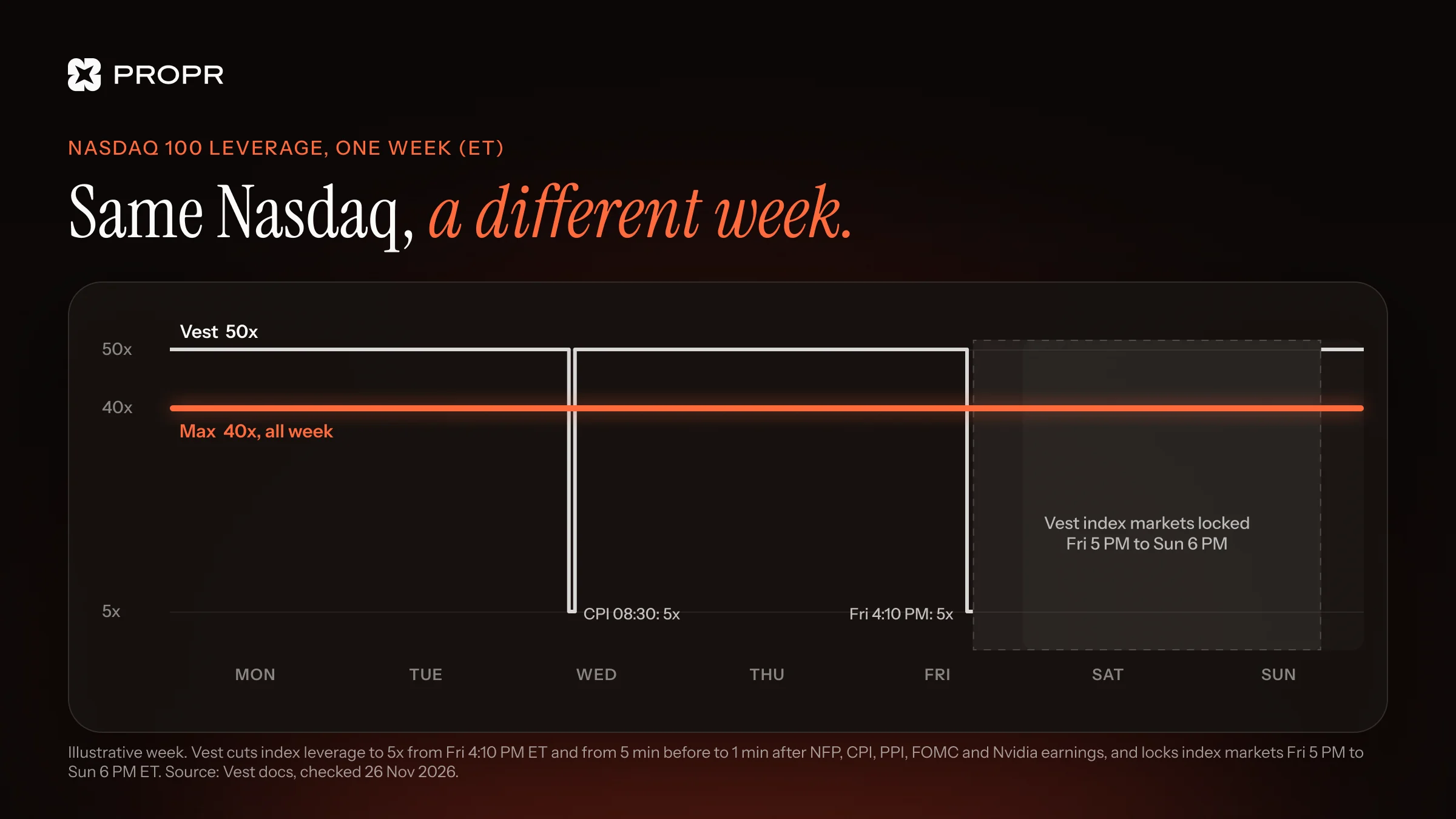
During the US week Vest offers more: 50x on the Nasdaq 100 and 75x on the S&P 500, against 40x on Max (Vest leverage). The difference is when. From Friday 4:10 PM ET until its markets reopen, Vest cuts index leverage to 5x and gold to 3x, and it does the same from 5 minutes before to 1 minute after NFP, CPI, PPI, FOMC and Nvidia earnings. Positions more than 2% over the new limit are reduced, and in accounts more than 1% below starting capital they are closed in full (temporary leverage limits).
Max has no leverage schedule. It's 40x on Friday afternoon, Sunday night and CPI morning alike.
2. Weekends: open against locked
Vest locks index and commodity markets, including the Nasdaq, S&P 500, gold and oil, from Friday 5 PM to Sunday 6 PM ET. Positions held through the lock stay open but can't be adjusted or closed until it lifts (Vest markets). On Max all four markets trade 24/7. If the Nasdaq perp moves hard on a Saturday, a Max trader can close or add at once; a Vest trader holding an index position waits for Sunday evening.
3. News days
The Max challenge has no news restriction, at full leverage. Once funded, a Max account can't open or close positions in the 2 minutes before and after a high-impact news event. Vest keeps trading open through releases but caps leverage at 5x (3x on gold, 1x on a single stock around its earnings) for that window. Max lets you trade the release at full size in the challenge; on Vest you can trade it at any stage, at lower leverage.
4. Daily loss limit: a trade-off, not a win
Since 23 November Vest's new plans have no hard daily loss limit. You can set your own, which closes your positions for the day without ending the account, and hard daily-limit plans return only in limited numbers, as Vest Experimental (loss limits, account tiers).
Every Max has a 3% daily loss limit: 3% of your start-of-day balance, reset at 00:00 UTC and checked on equity, so open positions count. Touching it ends the account. It's a large part of why Max costs less. If you trade with a daily stop anyway, the limit costs you little. If your style needs room for one bad day, Vest's structure suits you better.
5. Price
Account | 1-Step Max | Vest 1-Step, default build |
|---|---|---|
$5K | $49 | $90 |
$10K | $95 | $180 |
$25K | $249 | $430 |
$50K | $495 | $850 |
List prices on 26 November 2026, before discount codes. Vest raised its prices on 13 November and again on 23 November, when it removed hard daily-loss plans.
6. Fees
On market orders Max costs less: 0.001% per fill against Vest's 0.0025% taker. A $1M Nasdaq round trip with market orders costs $20 on Max and $50 on Vest. With limit orders Vest costs less, at 0% maker against 0.001% on Max (Vest fees). Both pass on funding while a position is open.
7. Drawdown and split: Vest gives more room
Vest's drawdown is 6% static by default and can be raised to 8%. Max's is 5% static. Vest's split goes up to 95% if you pay for it; Max pays 80%. Both floors are static, set from the starting balance and checked on equity.
8. Payouts and proof
Both pay on demand in USDC with no payout cap. Vest has no minimum and processes claims within 24 hours (claiming profit). Max starts at $20. Propr publishes every payout with its onchain transaction, its reserve wallets and its hedging positions on its transparency dashboard. Vest's payouts are onchain too, so independent trackers can count them, but Vest doesn't publish the list itself. Here is how to check any firm's payouts.
Which to pick
Pick Vest if you trade the New York session and want maximum leverage while it's open, you want no hard daily loss limit, you want 6% to 8% of drawdown room or a split above 80%, or you trade mostly with limit orders.
Pick 1-Step Max if you trade the Nasdaq or S&P 500 outside US hours or at the weekend, you've had leverage cut under you on a Friday or around CPI, you use market orders, or you want a cheaper challenge and trade with a daily stop anyway. Max is also the one to pick if you want a firm that publishes its payouts and reserve.
Frequently asked questions
Is Propr Max better than Vest?
Neither is better for everyone. Vest offers more leverage during the US week, more drawdown room and no daily loss limit. Max keeps 40x every hour, including weekends and news days in the challenge, costs less and charges less on market orders.
Does Vest have a daily loss limit?
Not on plans bought since 23 November 2026. Traders can set their own daily limit, which closes positions without ending the account. Hard daily-limit plans return in limited numbers under Vest Experimental.
Can you trade indices on Vest at the weekend?
No. Vest locks index and commodity markets from Friday 5 PM to Sunday 6 PM ET, and cuts index leverage to 5x from Friday 4:10 PM ET. Crypto trades 24/7.
Which has more Nasdaq leverage, Max or Vest?
Vest during the US week, at 50x against 40x. From Friday 4:10 PM ET, at the weekend and around major releases, Vest drops to 5x while Max stays at 40x.
Which is cheaper, Max or Vest?
Max. A $25K Max is $249 against $430 for Vest's default $25K 1-Step, and market orders cost 0.001% per fill against 0.0025%. Vest is cheaper on limit orders, at 0%.
Can US traders use Propr Max?
Yes. Propr accepts traders in the US and UK. Check the restricted countries in Propr's terms before you buy.
About the author
Connor Kirsten is Chief Marketing Officer at Propr and a founding team member of XBorg, the team that builds it. He has traded forex since 2016 and crypto since 2019, and writes Propr's comparisons and trading guides. X
Sources
All checked 26 November 2026. Vest: cross margin and leverage, temporary leverage limits, markets, hours and fees, loss limits, account tiers, claiming profit, Vest Capital pricing. Propr: 1-Step Max, rules, transparency dashboard.
Propr is an educational and evaluation service offered by Propr Limited, which is not licensed or regulated by the Financial Services Commission of the British Virgin Islands, or any US or EU financial authority. This service does not constitute a crypto-asset service or financial instrument, and falls outside the scope of the EU Markets in Crypto-Assets Regulation (MiCA). Availability varies by jurisdiction, and users are responsible for compliance with local laws. By participating, you are providing simulated trading signals to Propr Limited, you are not trading live financial instruments on your own behalf. Propr Limited exercises sole discretion over whether to replicate or act upon your signals in live trades. Evaluation fees are paid solely for platform access and are non-refundable. Any payout received is a performance fee based on evaluation metrics, not a return on capital or investment.
Written by
Chief Marketing Officer, Propr
Chief Marketing Officer at Propr and a founding team member of XBorg, the team that builds it. He has traded forex since 2016 and crypto since 2019, and writes Propr's comparisons and trading guides.
More from Connor Kirsten