
The best perps prop firms in 2026
Nine perps prop firms compared and scored on rules, sustainability, payouts, fees, markets, tools and transparency, with every rival's terms linked to its own pages.

Connor KirstenChief Marketing Officer, Propr
29 min. read
Key takeaways
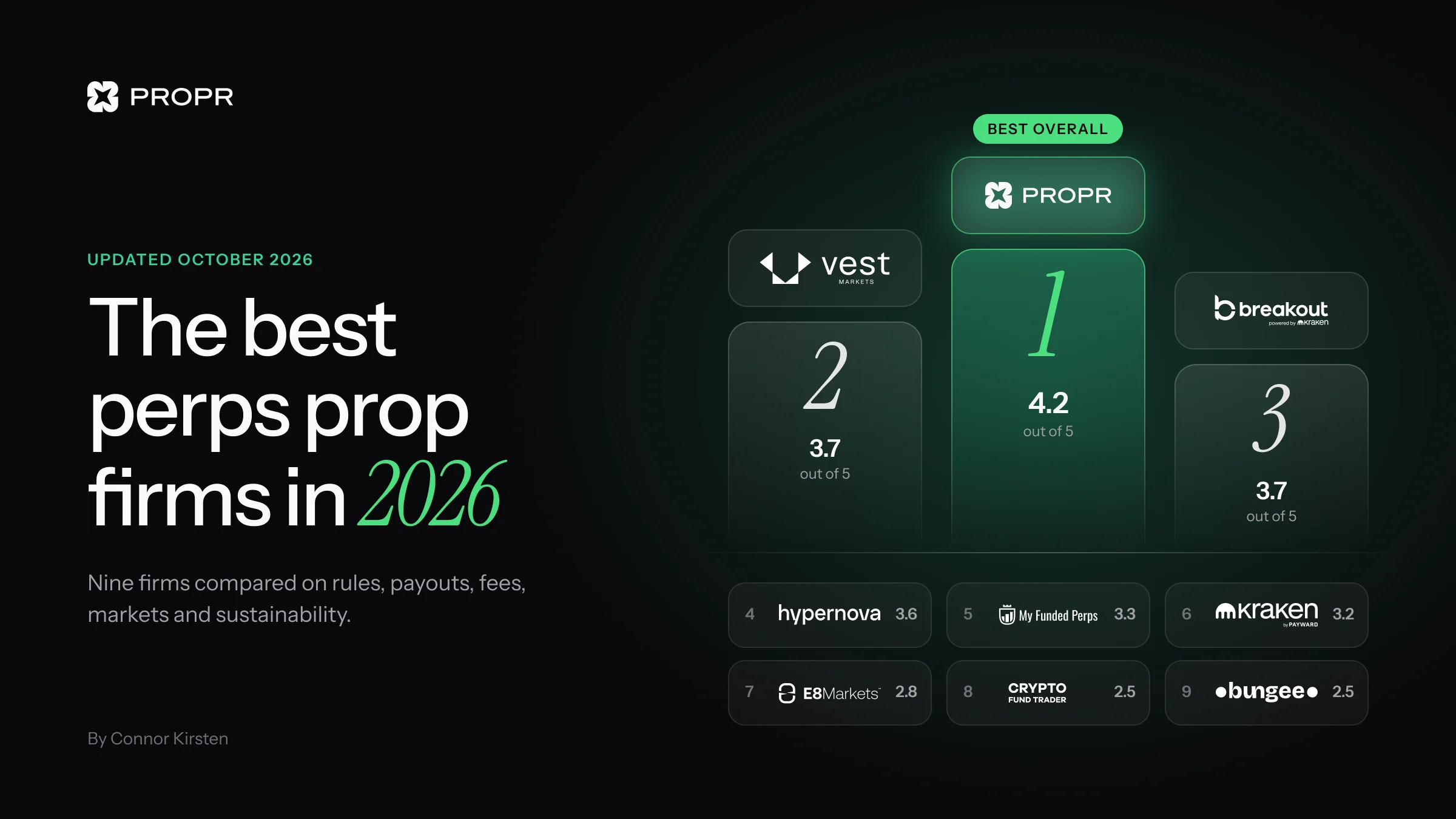
Propr scores 4.2 out of 5: static drawdown on every 1-Step challenge, on-demand USDC payouts and 148 markets that trade 24/7.
Vest has the lowest fees and the most index leverage, but US eligibility is unclear.
Breakout has the biggest payout record, over $80M, and the cheapest entry at $20 for a $5K Turbo.
Hypernova pays out fastest but is invite-only.
Quick answer
Propr is the best perps prop firm in 2026 for most traders, scoring 4.2 out of 5 across nine firms. It pairs static drawdown on every 1-Step challenge with on-demand USDC payouts (29-minute median over the last 30 days), 148 markets that all trade 24/7, an API, and a hedging book on Hyperliquid whose realised profit has covered about 22% of everything it has paid traders.
Best overall: Propr (4.2)
Lowest trading fees and most index leverage: Vest (3.7). 50x on Nasdaq 100, on accounts up to $25,000.
Biggest payout record and cheapest entry: Breakout (3.7). Over $80M paid to traders since launch, $20 for a $5K Turbo, owned by Kraken, 4.7 on Trustpilot from 1,183 reviews.
Fastest payouts: Hypernova (3.6). USDC in seconds, but small, young and invite-only.
Best newcomer with an API, US accepted: My Funded Perps (3.3)
Best for existing Kraken users: Kraken Prop (3.2)
Largest accounts: E8 Perpetuals (2.8). Up to $500,000 per account.
Most crypto pairs: Crypto Fund Trader (2.5). 715+ USDT perps on Bybit.
Newest entrant: Bungee (2.5)
Disclosure. Written by Connor Kirsten, Chief Marketing Officer at Propr. Propr scores itself first, so we publish the full scorecard below, show where rivals beat us, and link every fact about another firm to the page it came from. All data was checked on 22 October 2026.
Perps prop firms compared
Rank | Firm | Score | Best for | Challenge fee, $100K | Pay by card | Split | Max funded | Markets | API |
|---|---|---|---|---|---|---|---|---|---|
1 | 4.2 | Best overall | $450 to $999 | Yes, or crypto | 80% reward split | $300,000 | 148: 92 crypto, 47 stocks, 2 indices, 5 commodities, 2 FX, all 24/7 | Yes | |
2 | 3.7 | Lowest fees, index leverage | No $100K size. $130 to $450 for $25K | Yes, or crypto | 80% or 90% | $25,000 per account | Crypto, ~60 stocks and ETFs, ES, NQ, RTY, YM, commodities, FX | Not on funded accounts | |
3 | 3.7 | Payout record, cheapest entry | $330 to $800 | Yes, PayPal or crypto | 80%, 90% as an add-on | $200,000 | 72: 68 crypto, Nasdaq 100, S&P 500, crude, silver | No | |
4 | 3.6 | Fastest payouts | $400 to $1,350 | No, USDC on Arbitrum only | 80% | $300,000 | 106: crypto, stocks, indices, commodities, FX | Coming soon | |
5 | 3.3 | Newcomer with an API | $360 to $870 | Yes in most countries, or crypto | 80%, 90% as an add-on | $300,000, $100,000 per plan | 122: crypto, 31 stocks, 7 indices, 12 commodities, 6 FX | Yes | |
6 | 3.2 | Kraken users | $330 to $800 | Paid from your Kraken balance | 80%, 90% as an add-on | $200,000 | 60+ crypto, Nasdaq 100, S&P 500 | No | |
7 | 2.8 | Largest accounts | $468 to $488 | Yes, or crypto | 80% on E8 One. E8 Pro holds back 50% | $500,000 per account | Crypto, stocks, indices, metals, energy, FX | Bots banned | |
8 | 2.5 | Most crypto pairs | $619 (1-Phase), $660 (2-Phase) | Yes, PayPal or crypto | 80%, 90% as an add-on | $300,000 | 715+ USDT perps on Bybit, crypto only | Trades on your own Bybit subaccount | |
9 | 2.5 | Newest entrant | $360 to $900 | No, USDC on Base only | 80% | $110,000 combined | 30: 19 crypto, 6 stocks, 2 indices, 3 commodities | Banned |
Fees are list prices without promo codes. Vest has no $100K account, so its $25K price is shown. Each firm's sources are linked in its review below.
Rules, leverage and payouts
Firm | Max drawdown | Daily loss | Consistency or profit cap | Nasdaq 100 leverage | BTC leverage | Payouts |
|---|---|---|---|---|---|---|
Propr | 3%, 5% or 6% static on 1-Step. 8% trailing on 2-Step | 3% of start-of-day balance on 1-Step, 5% on 2-Step. Checked on equity. Resets 00:00 UTC | None | 10x | 10x | On demand in USDC, $20 minimum. 29-minute median, 99% within 24 hours |
Vest | 6% static | 3%, 4% or none, chosen at purchase. Resets 20:00 ET | None | 50x | 15x or 25x (its docs conflict) | Claim any time, credited within 24 hours in USDC |
Breakout | 3%, 5% or 6% static | 3% of balance, open positions excluded. Resets 00:30 UTC | None | 10x | 10x | Any time, approved in 12 to 24 hours, USDC on Ethereum, $50 minimum |
Hypernova | 3% to 8% static, on equity | 3% to 5% of the 00:00 UTC balance, on equity | None | 10x | 10x | On demand, USDC on Arbitrum by smart contract, seconds, no minimum |
My Funded Perps | 3%, 5% or 6% static. Locks at starting balance after the first payout | 3% on equity, or none on Elite. Resets midnight New York | None. $100,000 lifetime payout cap per user | 12x (40x on Elite) | 10x | Once a day (Elite on demand), via Rise, $100 minimum |
Kraken Prop | 3%, 5% or 6% static | 3%, including unrealised P&L, commissions and funding. Resets 00:30 UTC | None stated | 10x | 10x | On demand to your Kraken account, within 24 hours |
E8 Perpetuals | 8% static on E8 Pro. Trailing on E8 One | 2.5% on E8 Pro, 4% on E8 One | E8 Pro counts 2% profit a day. E8 One has a 40% best-day rule | 15x | 15x | Via Rise, WorkMarket or Aeropay. Median 24 hours. No direct USDC |
Crypto Fund Trader | 6% trailing on 1-Phase, 10% static on 2-Phase | 4% (1-Phase) or 5% (2-Phase) on equity. Resets 00:05 UTC | None | No indices on Bybit | Up to 100x | After 15 traded days or 30 calendar days. Bank or crypto |
Bungee | 3%, 5% or 6% static. Account resets after each payout | 3% on equity. Resets 00:00 UTC | None | 20x | 10x | $50 minimum, $20,000 per 24 hours, target 1 business day |
What is a perps prop firm?
A perps prop firm runs its challenges and funded accounts on perpetual futures rather than dated futures contracts or CFDs. You pay a one-time challenge fee, trade a simulated account to a target without breaching the loss limits, and receive a share of the performance you record once funded.
Every firm in this list runs simulated accounts in some form. Perps have no expiry, so there is no rollover, and on most of these firms crypto and index perps trade through the weekend.
How we scored the firms
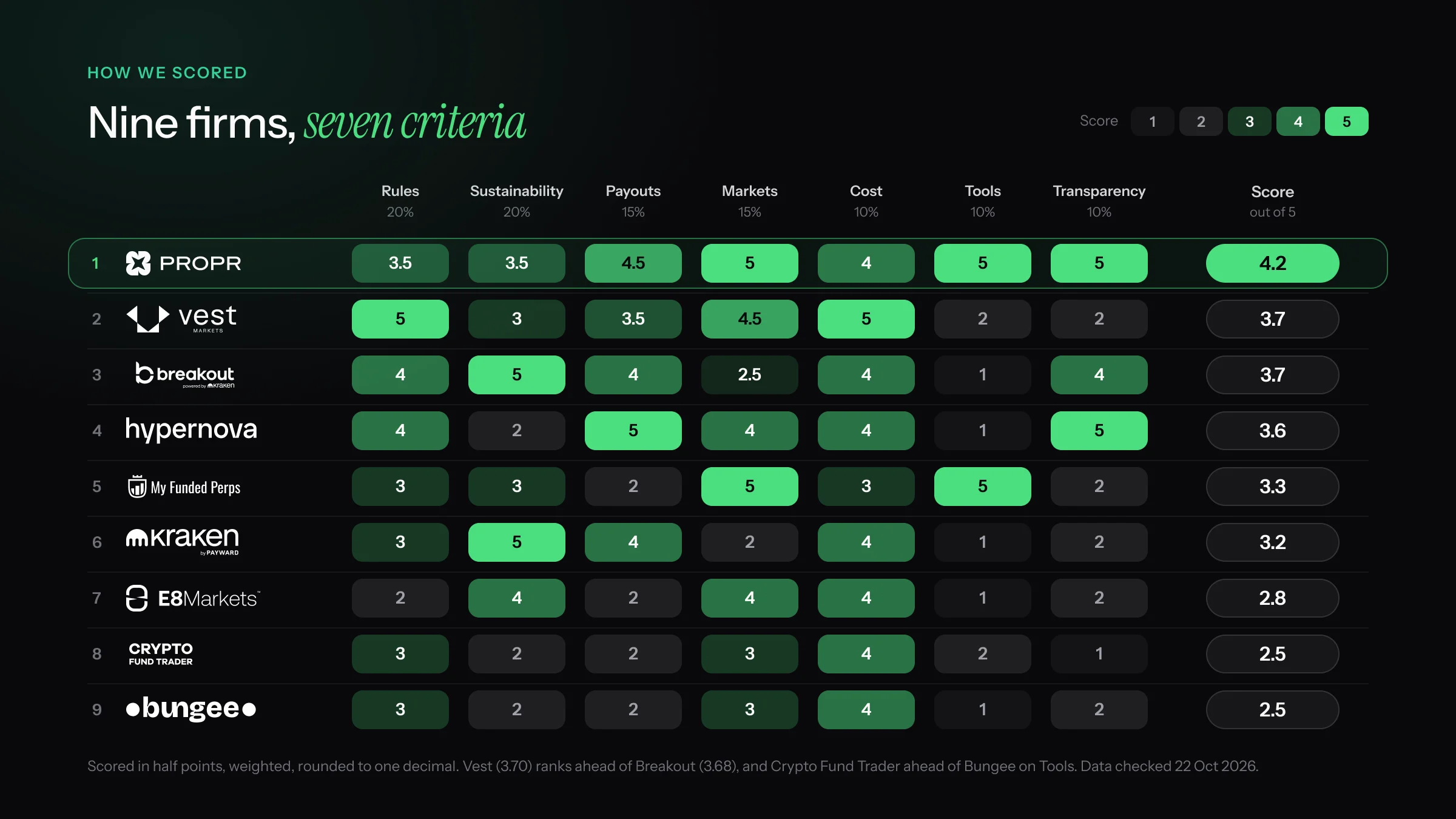
We scored each firm from 1 to 5, in half points, on seven criteria. The two heaviest are the rules, because they decide whether you keep a funded account, and sustainability, because a firm that cannot keep paying is worth nothing to a funded trader, however loose its rules.
Criterion | Weight | What a 5 looks like |
|---|---|---|
Rules | 20% | Static drawdown, no consistency rule, no minimum days, no time limit, no profit cap, few banned strategies |
Sustainability | 20% | Strong backing or ownership, scale, a payout record measured in years, and a published reserve and hedging record that shows payouts are covered |
Payouts | 15% | On demand, fast published settlement, low minimum, no daily or lifetime cap, no buffer held back, large maximum account |
Markets and leverage | 15% | Crypto, indices, stocks, commodities and FX in one account, trading 24/7 |
Cost | 10% | Low challenge fee per $100,000, low trading fees, card payment accepted |
Tools | 10% | A documented API with bots allowed |
Transparency | 10% | Public payout, revenue and reserve data, and consistent rules across its own pages |
Firm | Rules | Sustainability | Payouts | Markets | Cost | Tools | Transparency | Score |
|---|---|---|---|---|---|---|---|---|
Propr | 3.5 | 3.5 | 4.5 | 5 | 4 | 5 | 5 | 4.2 |
Vest | 5 | 3 | 3.5 | 4.5 | 5 | 2 | 2 | 3.7 |
Breakout | 4 | 5 | 4 | 2.5 | 4 | 1 | 4 | 3.7 |
Hypernova | 4 | 2 | 5 | 4 | 4 | 1 | 5 | 3.6 |
My Funded Perps | 3 | 3 | 2 | 5 | 3 | 5 | 2 | 3.3 |
Kraken Prop | 3 | 5 | 4 | 2 | 4 | 1 | 2 | 3.2 |
E8 Perpetuals | 2 | 4 | 2 | 4 | 4 | 1 | 2 | 2.8 |
Crypto Fund Trader | 3 | 2 | 2 | 3 | 4 | 2 | 1 | 2.5 |
Bungee | 3 | 2 | 2 | 3 | 4 | 1 | 2 | 2.5 |
Weighted scores are rounded to one decimal. Vest (3.70) and Breakout (3.68) both round to 3.7, and Vest ranks ahead on Rules. Crypto Fund Trader and Bungee tie at 2.45, and Crypto Fund Trader ranks ahead on Tools. Propr scores 3.5 on Rules, because a payout resets the account to its starting balance, both limits are checked on equity and the Turbo 1-Step leaves only 3% of room. It scores 3.5 on Sustainability: its hedging profit offsets a share of its payouts, which no other firm here publishes, but it launched in March 2026 and its payout record is months, not years. It scores 4.5 on Payouts because Hypernova settles faster. Vest scores higher than Propr on Rules and Cost, and Breakout, Kraken Prop and E8 score higher on Sustainability.
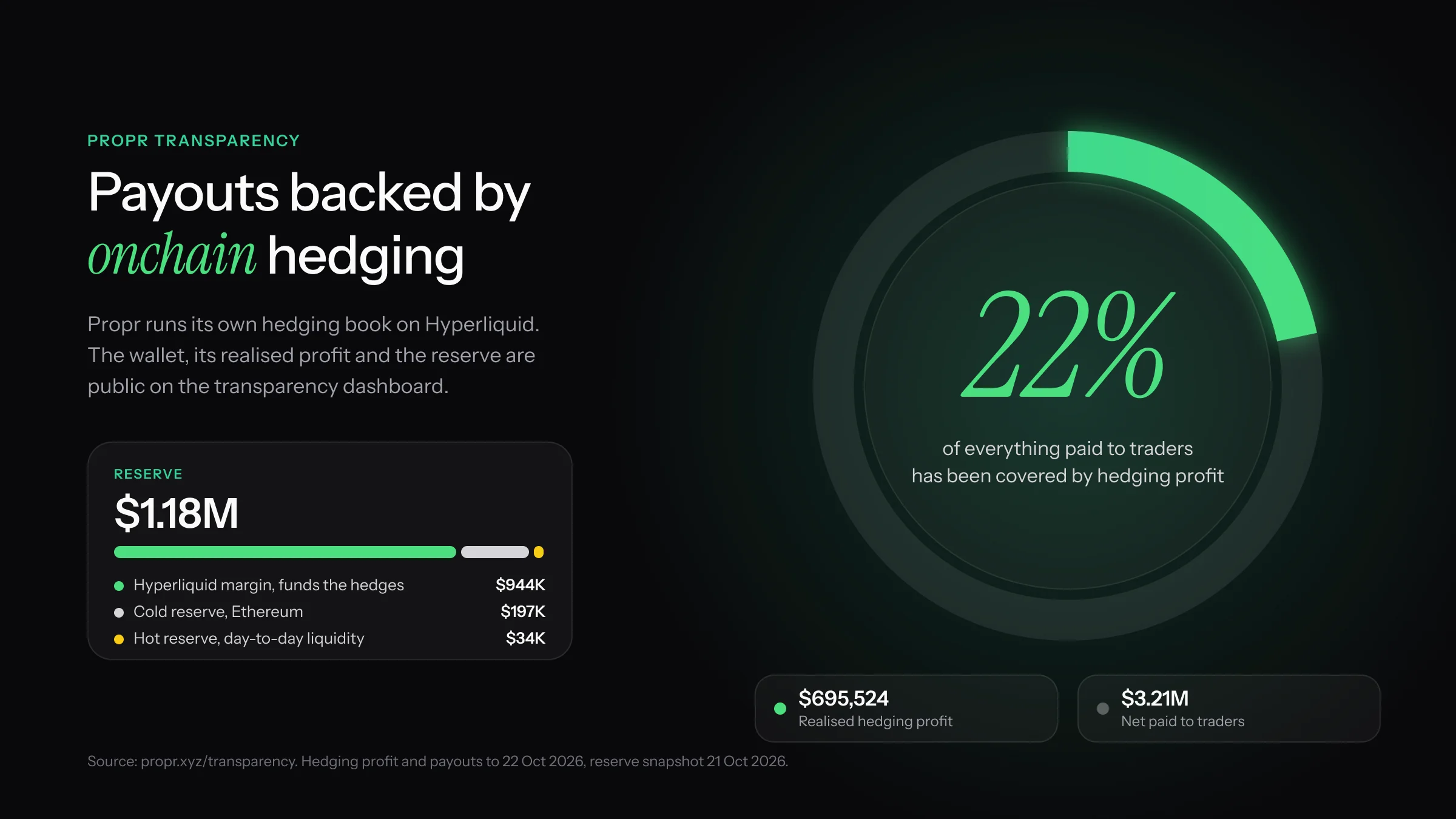
How we judged sustainability. A funded account is only worth something if the firm is still paying next year. We scored ownership and backing, scale, how long the firm has paid out, and whether it publishes a reserve and a hedging record. Firms owned by large exchanges (Breakout, which says it has paid more than $80M to traders since launch, and Kraken Prop) or with long payout records (E8) score highest. Hypernova scores low here: it is under a year old, invite-only, funded by a $3M pre-seed, had 85 funded traders when we checked, and publishes no hedging record, so on its own numbers its payouts are met from challenge revenue and its reserve. Propr hedges part of its exposure onchain on Hyperliquid: by 22 October its realised hedging profit was $695,524, against $3.21M paid to traders, so about 22% of payouts were covered by hedging rather than challenge fees.
Where the data came from. We read each firm's live rules, help centre, pricing, payment and stats pages on 22 October 2026. Where a firm's own pages disagreed, we used its most recently updated rules or help page and noted the conflict in its review. Propr's figures come from its rules page, asset universe and the data behind its transparency dashboard.
What we have not done yet. This edition is built from each firm's published terms. We are buying the entry challenge at every firm in this list and will add first-hand notes and screenshots in the next update. Where a figure comes only from the firm itself, such as a payout total, we say so.
We update this guide monthly. Rules in this category change often, so check a firm's current terms before you buy.
The best perps prop firms in 2026, reviewed
1. Propr: best overall (4.2)
Propr is a perps prop firm built on Hyperliquid, launched in March 2026 by XBorg and backed by SwissBorg. It sells four challenges (Classic, Turbo and Pro 1-Step, plus Classic 2-Step) from $25 to $1,998, on accounts of $5,000 to $200,000.
What stands out
Static drawdown on all three 1-Step challenges: 6% Classic, 5% Pro, 3% Turbo. No consistency rule, no minimum days, no time limit and no profit cap.
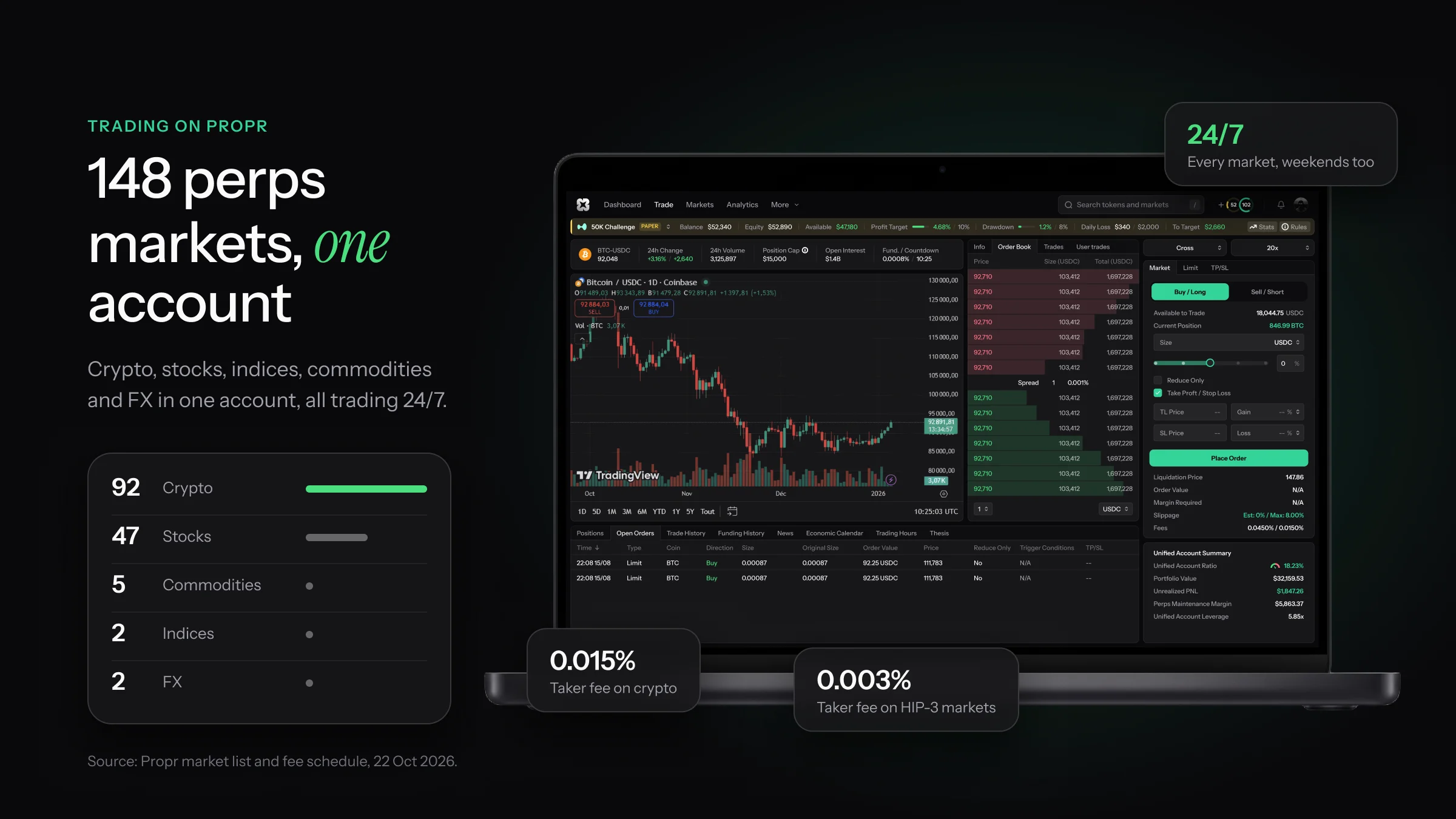
The widest market list here: 148 markets on 22 October, all tradable 24/7, including the S&P 500 and Nasdaq 100 at 10x, 47 stocks such as SpaceX, Nvidia and Micron, gold, silver and oil at 8x, and FX at 25x.
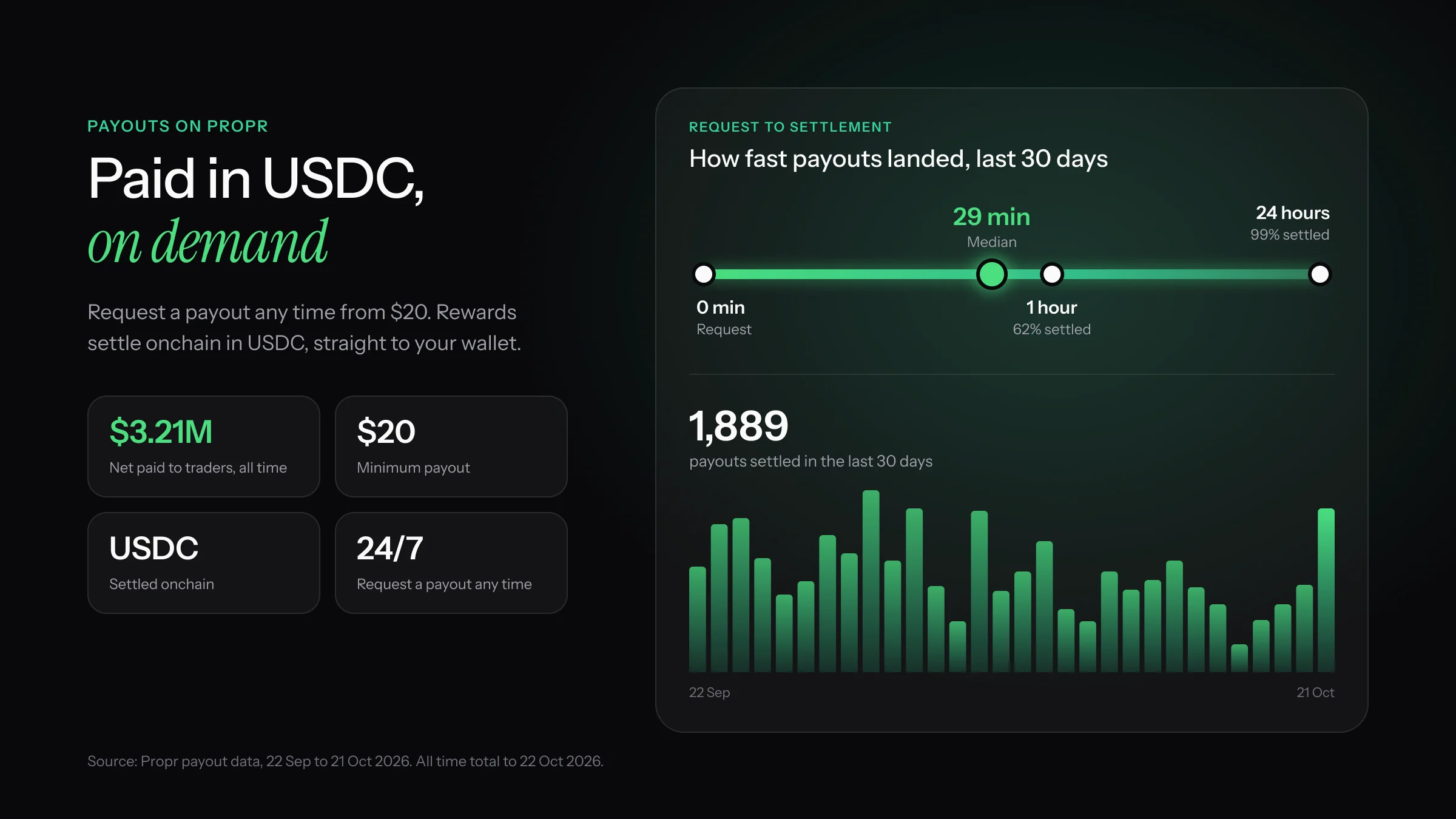
Rewards on demand in USDC with a $20 minimum and no cap on requests. Over the 30 days to 21 October, the median payout settled 29 minutes after the trader requested it, and 99% settled within 24 hours.
$3.21M paid to traders across 6,105 payouts and 1,715 traders funded.
A hedging book on Hyperliquid with $695,524 of realised profit by 22 October, about 22% of everything paid to traders, published on the transparency dashboard next to revenue, payouts and the reserve.
A public reserve of about $1.18M in onchain wallets (21 October), and Propr hedges part of its exposure on Hyperliquid in positions anyone can check.
A documented API with REST, WebSocket and Python and JS SDKs. Bots and copy trading between your own accounts are allowed.
Low trading fees: 0.015% taker on crypto and 0.003% on indices, stocks and commodities, per the asset universe page. Challenges can be paid by card or crypto.
Watch out for
Challenge fees are higher than Breakout and Kraken Prop on matching sizes: $450 against $330 for a $100K Turbo.
Turbo is the cheapest way in, not the easiest. Its 3% static drawdown is half the room of Classic.
Both limits are checked on equity, so a floating loss counts.
A payout sweeps everything above the starting balance and resets the account to it, and all positions must be closed first.
Most altcoins are capped at 2x, and stocks at 4x.
A short review record: 4.3 on Trustpilot from 64 reviews, against Breakout's 1,183. Propr launched in March 2026, so its payout record is months, not years.
Every signal on Propr is simulated. Propr hedges part of its own exposure onchain on Hyperliquid, and those positions, the reserve wallets and the payout history are published on the transparency dashboard.
Sources: rules, asset universe, transparency, API docs, Trustpilot.
2. Vest: lowest fees and most index leverage (3.7)
Vest Markets runs its own perps exchange and a prop programme, Vest Capital. Its contracting entity is in Panama and its team is in New York. It raised $13M led by Portal Ventures, announced in October 2026.
What stands out
The lowest trading fees here: 0% maker, and 0.0025% taker on ES and NQ.
The most index leverage on funded accounts: 75x on ES and 50x on NQ, RTY and YM.
Flexible rules. You choose the target (10% or 20%) and the daily loss limit (3%, 4% or none), with 6% static drawdown and no consistency rule.
Cheap entry: a 2-Step $5K is $15, and Instant accounts start at $10, payable by card or crypto. Splits of 80% or 90%, and 95% on Instant.
Watch out for
The standard maximum is $25,000 per account. A $50K card appears on the homepage but not in the docs.
Its own pages conflict on whether funded capital is real or simulated, on BTC leverage (15x or 25x) and on maximum leverage (50x or 100x).
Its exchange terms list the US and UK as prohibited, while its prop terms do not, so check before buying.
Non-crypto markets follow a weekend schedule on funded accounts. Payout figures are self-reported, and there are no Trustpilot reviews yet.
Vest vs Propr
Vest wins on trading fees, index leverage and the option of no daily loss limit. Propr wins on account size ($200,000 against $25,000), on all markets trading through the weekend, on clear US and UK availability, and on a public payout and reserve record. Pick Vest for high-leverage NQ or ES scalping on a small account. Pick Propr for larger accounts and a broader market list.
Sources: overview, account tiers, loss limits, leverage, payouts, prop terms, funding round.
3. Breakout: biggest payout record and cheapest entry (3.7)
Breakout launched in 2023 and was bought by Kraken in a deal announced in September 2025. It sells three 1-Step challenges (Turbo, Pro and Classic) and has closed its 2-Step to new traders. Its Spark challenge for futures traders sold out its first 1,500 seats, and it says it has paid more than $80M to traders since launch.
What stands out
The lowest challenge fees here, shared with Kraken Prop: $20 for a $5K Turbo and $330 for a $100K Turbo.
Static drawdown of 3%, 5% or 6%, and a daily loss limit that ignores open positions. No consistency rule and no time limit.
The strongest review record: 4.7 on Trustpilot from 1,183 reviews.
The biggest payout record here: more than $80M paid to traders since launch, by its own count, and a public leaderboard of traders ranked by lifetime payouts.
Kraken ownership, iOS and Android apps, and payment by card, PayPal or crypto.
Watch out for
Only four non-crypto markets: Nasdaq 100, S&P 500, crude oil and silver. No single stocks and no FX.
No API trading.
Trading costs of 0.04% per side plus a 0.033% daily swap, the most common complaint in its recent reviews.
Payouts only in USDC on Ethereum, so you pay gas, with a $50 minimum. Funded capital tops out at $200,000.
Breakout vs Propr
Breakout is cheaper to enter ($330 against $450 for a $100K Turbo) and has a far longer payout and review record ($80M+ paid since launch against $3.21M). Propr is cheaper to trade (0.015% taker on crypto against 0.04% plus a daily swap), offers 148 markets against 72 including 47 stocks and FX, allows API trading, and pays in USDC with a $20 minimum and a 29-minute median. Pick Breakout for low-cost crypto trading backed by the biggest payout record here. Pick Propr if you trade more than crypto or run bots.
Sources: homepage and payout leaderboard, challenge types, drawdown, leverage, fees, payouts, Kraken acquisition, Trustpilot.
4. Hypernova: fastest payouts (3.6)
Hypernova is a Cayman-registered firm founded in September 2025 by a London team, with a $3M pre-seed led by Lemniscap. It runs a 1-Step assessment in risk tiers from $25 to $1,950, on accounts of $5,000 to $200,000, and is still invite-only.
What stands out
The fastest payouts in this list: USDC on Arbitrum paid by smart contract in seconds, with gas covered and no minimum.
The most detailed stats page in the category, with pass rates by tier, payouts, reserve and funded count. On 22 October it showed $1.83M paid to 298 traders.
Static drawdown and no consistency rule, minimum days or time limit.
106 markets priced from Hyperliquid, including stocks, indices, oil and FX, with 10x on BTC, ETH, SOL and both US indices.
Watch out for
Young and small: founded in September 2025, funded by a $3M pre-seed, with 85 funded traders and a $591K USDC reserve when we checked. Over the last 90 days its own stats show $1.54M paid out against $1.84M of challenge revenue.
Closed beta: you need an invite or a Fast Track score from your trading history to get in. Challenges are paid in USDC on Arbitrum only, with no card option.
Tight tiers. The $25 Tight tier allows 3% drawdown, and any touch of a limit on equity ends the account.
Four Trustpilot reviews.
No API yet, and its own pages disagree on market count (106 or 140), leverage and payout speed.
Hypernova vs Propr
Hypernova pays faster (seconds against Propr's 29-minute median) and its stats page goes further than most, with pass rates by tier. Propr offers more markets (148 against 106), an API, a 2-Step option, open sign-up, and a longer payout record ($3.21M against $1.83M), and Propr's hedging profit covers part of its payouts, which Hypernova does not publish. Pick Hypernova if you have an invite and payout speed is everything. Pick Propr if you want a larger, longer payout record, or want to start today.
Sources: rulebook, stats, markets, terms, funding round, Trustpilot.
5. My Funded Perps: best newcomer with an API, US accepted (3.3)
My Funded Perps is the perps brand of the futures firm MyFundedFutures, run by Funding Perpetuals Holdings in Delaware. It launched as Funding Perpetuals, rebranded on 3 September 2026 and opened payouts on 11 September. It sells four 1-Step plans (Select, Prime, Signature and Elite) from $40.
What stands out
122 markets: 66 crypto, 31 stocks, 12 commodities, 7 indices and 6 FX.
A full API with REST, WebSocket, an MCP server and a CLI.
US traders are accepted. Static drawdown, with no consistency rule or minimum days.
The Elite plan offers 40x on the Nasdaq 100 and S&P 500, a no-daily-loss option and on-demand payouts.
Watch out for
A $100,000 lifetime payout cap per user, and funded allocation capped at $100,000 per plan.
On Select, Prime and Signature, the drawdown floor locks at your starting balance after the first payout.
Funded accounts close after seven days without a trade.
Payouts go through Rise, with a $100 minimum and no stated delivery time.
Crypto costs 0.03% per fill plus a 0.03% daily swap. The $250M+ paid figure on its homepage belongs to MyFundedFutures, not the perps product.
My Funded Perps vs Propr
My Funded Perps offers a similar multi-asset menu and API, cheaper entry ($40 for a $10K Select against $50 for a $10K Turbo) and higher index leverage on Elite. Propr has no lifetime payout cap, pays in USDC on demand with a $20 minimum, charges lower crypto fees, and publishes its own payout and reserve data rather than a parent brand's. Pick My Funded Perps for 40x index leverage on Elite. Pick Propr if you plan to withdraw often or for more than $100,000 in total.
Sources: homepage, docs, restricted countries, rebrand, Trustpilot.
6. Kraken Prop: best for Kraken users (3.2)
Kraken Prop launched on 27 May 2026 inside Kraken Pro, run by the Kraken subsidiary Payward Oceanic. It uses Breakout's pricing and rule sets under different names (Advanced, Intermediate and Starter) and pays out to your Kraken account.
What stands out
The Kraken brand, and no new platform to learn if you already use Kraken Pro.
Breakout's low prices: $20 for a $5K Advanced and $330 for a $100K Advanced.
Static drawdown, no time limit, and payouts on demand, reviewed within 24 hours.
10x on BTC, the Nasdaq 100 and the S&P 500, all trading 24/7.
Watch out for
The daily loss limit counts unrealised P&L, commissions and funding.
60+ crypto pairs and two indices, with most altcoins at 2x. No stocks, commodities or FX yet.
No API, MT5 or TradingView. Costs of 0.04% per side plus 0.033% a day, and the challenge fee comes out of your Kraken balance rather than a card checkout.
Not available in the UK or India, and restricted in several other countries and US states. Kraken's own pages conflict on whether funded trading is simulated.
Kraken Prop vs Propr
Kraken Prop is cheaper to enter and sits inside an exchange many traders already use. Propr offers more than twice the markets, including stocks, commodities and FX, an API, lower trading fees, availability in the UK, and public payout and reserve data. Pick Kraken Prop if you live in Kraken Pro and trade BTC and US indices. Pick Propr for range and transparency.
Sources: Kraken Prop, plans and pricing, drawdown, payouts, leverage update, launch.
7. E8 Perpetuals: largest accounts (2.8)
E8 Markets, a Dallas-based firm founded in 2021, added perps to its E8 Terminal in September 2026, priced from Hyperliquid data. Perps run inside its E8 One and E8 Pro challenges, on accounts of $5,000 to $500,000.
What stands out
Up to $500,000 per account, the largest here.
15x on BTC, ETH, indices, metals and energy, and 25x on FX.
E8 Pro uses 8% static drawdown with no consistency rule, and pays out daily.
E8 says it has paid over $79M across all its products, not only perps.
Watch out for
E8 Pro counts only 2% of profit a day toward the target, and lets you withdraw only 50% of profit, holding the rest as a buffer.
E8 One uses a trailing drawdown and a 40% best-day rule in its funded stage.
Payouts go through Rise, WorkMarket or Aeropay, with no direct USDC and a 24-hour median.
Trustpilot has hidden E8's rating for a breach of its guidelines. Bots and AI agents are banned, and the UAE is restricted.
E8 Perpetuals vs Propr
E8 offers bigger accounts and higher leverage on BTC, ETH and indices. Propr pays your full 80% reward share on demand in USDC, has no daily profit cap or best-day rule, allows bots, and offers static drawdown on every 1-Step challenge. Pick E8 if account size matters most. Pick Propr if you want your whole reward when you ask for it.
Sources: E8 Pro rules, leverage, platform, payouts, PFM listing, Trustpilot.
8. Crypto Fund Trader: most crypto pairs (2.5)
Crypto Fund Trader launched in November 2022 and is run from Zug, Switzerland. It has no separate perps product: you trade perps by choosing Bybit as the platform on a 1-Phase or 2-Phase challenge and linking your own Bybit subaccount.
What stands out
The most crypto markets here: 715+ USDT perps on Bybit, at up to 100x.
Bybit's own fees with no markup, and a cheap entry at $40 for a $5K 1-Phase.
No consistency rule, minimum days or time limit. Up to $300,000 funded.
A long record for a crypto prop firm, with $21.8M paid according to its homepage.
Watch out for
Crypto only on the perps route. Stocks, indices and metals are CFDs on MT5 and Match-Trader instead.
The 1-Phase uses a 6% trailing drawdown.
Payouts wait for 15 traded days or 30 calendar days unless you buy the weekly add-on.
On the Swiss regulator FINMA's warning list since August 2024, and Trustpilot has suppressed its rating for a guidelines breach. US traders cannot use the Bybit route.
Crypto Fund Trader vs Propr
Crypto Fund Trader offers far more crypto pairs and higher crypto leverage, on Bybit's own interface. Propr offers static drawdown on every 1-Step challenge, payouts from your first day funded, stocks, indices, commodities and FX in the same account, US access, and a public reserve. Pick Crypto Fund Trader for 100x on small-cap altcoins. Pick Propr for multi-asset perps and faster access to rewards.
Sources: Bybit programme, FAQ, terms, PFM listing, FINMA warning list report, Trustpilot.
9. Bungee: newest entrant (2.5)
Bungee's Funded Perps is built by the team behind Socket, whose backers include Coinbase Ventures, Lightspeed and Mark Cuban. It sells three 1-Step tracks (Classic, Pro and Turbo) on accounts of $10,000 to $100,000.
What stands out
Low trading fees of 0.015% on maker and taker orders.
20x on the S&P 500 and Nasdaq 100, and 10x on BTC and gold.
Static drawdown with no consistency rule, minimum days or time limit, and a full rulebook published on GitHub.
Watch out for
Very early: $440 in rewards claimed at the time of checking, no named legal entity on its site, and one Trustpilot review, which predates the product.
Bots, API trading, HFT, scalping and hedging are banned.
30 markets, with most altcoins and all stocks at 2x.
Challenges are paid in USDC on Base only, with no card option.
Payouts are capped at $20,000 per 24 hours, each payout resets the account to its starting balance, and the payout method is not stated on the live site.
Bungee vs Propr
Bungee offers higher index leverage (20x against 10x) at a similar trading fee. Propr offers five times the markets, allows bots and scalping, accounts up to $200,000, no daily payout cap, and $3.21M of payout history. Pick Bungee if you want to back a new team early. Pick Propr for a proven payout record.
Sources: Funded Perps, rules, markets, FAQ, Trustpilot.
How to choose a perps prop firm
Pick on the rule most likely to end your account, not on the headline split. Nearly every firm here pays 80% or more, but their drawdown, payout and strategy rules differ a lot.
If you are | Look at | Why |
|---|---|---|
A futures trader who wants NQ, ES or gold on the weekend | Propr, Vest | Propr offers 10x on both US indices and 8x on gold, all 24/7. Vest offers 50x to 75x on indices, on accounts up to $25,000 |
A crypto-only trader watching costs | Breakout, Kraken Prop | $20 entry and $330 for $100K, with 10x on BTC |
Running bots or AI agents | Propr, My Funded Perps | Both document an API and allow automation. Bungee and E8 ban bots |
Trading single stocks | Propr, My Funded Perps, Hypernova, Vest | Breakout and Kraken Prop have no single stocks |
Planning to withdraw often | Propr, Hypernova, Breakout | All pay USDC on demand. Hypernova is fastest but invite-only. My Funded Perps caps lifetime payouts at $100,000, Bungee caps payouts at $20,000 a day, and E8 Pro holds back 50% |
Chasing the biggest account | E8 Perpetuals | Up to $500,000 per account |
Five questions to ask any firm before you buy
Is the drawdown static or trailing, and does it move after a payout?
Is the daily loss limit based on balance or equity, and when does it reset?
What are the trading fees, swap and funding charges per day?
What is the payout minimum, the daily and lifetime cap, and the published settlement time?
Is API trading allowed in writing, not only advertised?
Frequently asked questions
What is the best perps prop firm in 2026?
Propr scores highest in our comparison of nine firms, at 4.2 out of 5. Vest has the lowest trading fees, Breakout has the biggest payout record (over $80M) and the cheapest entry, and Hypernova pays out fastest but is invite-only.
What is a perps prop firm?
A perps prop firm runs challenges and funded accounts on perpetual futures instead of dated futures contracts or CFDs. Perps have no expiry, so there is no rollover, and crypto and index perps usually trade 24/7.
Are perps prop firms legit?
They are challenge services: you pay a fee to trade a simulated account, and the firm pays a share of the performance you record once funded. Check how long a firm has operated, whether it publishes payout data, and what its reviews say about denied payouts.
Can US traders use perps prop firms?
Yes, at several. Propr, My Funded Perps and E8 accept US traders. Kraken Prop excludes several US states, Vest's exchange terms prohibit the US, and Crypto Fund Trader's perps run on Bybit, which does not serve US residents.
Which perps prop firm has the most leverage on Nasdaq?
Vest, at 50x on NQ and 75x on ES for funded accounts, followed by My Funded Perps Elite at 40x. Propr, Breakout, Kraken Prop and Hypernova offer 10x.
Which perps prop firms allow bots and API trading?
Propr and My Funded Perps both document an API and allow automation. Hypernova's API is coming soon, Vest does not allow API trading on funded accounts, and Bungee and E8 ban bots.
Which perps prop firm is cheapest?
Breakout and Kraken Prop, at $20 for a $5K account and $330 for $100K. Vest is cheapest to trade, with 0% maker fees, and its Instant accounts start at $10.
Which perps prop firm pays out fastest?
Hypernova, with smart-contract payouts in seconds. Propr's median was 29 minutes from request to settlement over the last 30 days, and Breakout, Kraken Prop and Vest quote up to 24 hours.
Do perps prop firms charge funding fees?
Most do in some form. Propr and Hypernova apply Hyperliquid funding rates, while Breakout, Kraken Prop and My Funded Perps charge a fixed daily swap of 0.03% to 0.033%.
Which perps prop firms accept card payments?
Propr, Vest, Breakout, My Funded Perps, Crypto Fund Trader and E8 accept cards. Breakout and Crypto Fund Trader also take PayPal. Hypernova and Bungee take USDC only, and Kraken Prop charges the fee to your Kraken balance.
What is the difference between static and trailing drawdown?
A static drawdown floor is set when the account opens and never moves. A trailing floor rises with your highest balance or equity, so profit you give back can breach the account.
About the author
Connor Kirsten is Chief Marketing Officer at Propr and a founding team member of XBorg, the team that builds it. He has traded forex since 2016 and crypto since 2019, and writes Propr's comparisons and trading guides. X
Changelog
24 October 2026: first published. Nine firms scored on seven criteria, including sustainability. Data checked on 22 October 2026.
Propr is an educational and evaluation service offered by Propr Limited, which is not licensed or regulated by the Financial Services Commission of the British Virgin Islands, or any US or EU financial authority. This service does not constitute a crypto-asset service or financial instrument, and falls outside the scope of the EU Markets in Crypto-Assets Regulation (MiCA). Availability varies by jurisdiction, and users are responsible for compliance with local laws. By participating, you are providing simulated trading signals to Propr Limited, you are not trading live financial instruments on your own behalf. Propr Limited exercises sole discretion over whether to replicate or act upon your signals in live trades. Evaluation fees are paid solely for platform access and are non-refundable. Any payout received is a performance fee based on evaluation metrics, not a return on capital or investment.